
How Page EEPROM can enhance IoT devices
Innovative EEPROM memory enables efficient and reliable IoT
IoT applications need memory that can store data reliably, support frequent updates, and operate with minimal power consumption. Whether you are designing smart meters, asset trackers, industrial sensors or smart home devices, the Page EEPROM combines ultra‑low power operation with flexible EEPROM storage, high endurance, and code management capabilities.
More importantly, the Page EEPROM enables more efficient, reliable, and easy‑to‑manage IoT devices.
Why the Page EEPROM stands out
By bringing together the flexibility of standard EEPROM and the efficiency of flash memory in a single device, ST’s smart Page EEPROM helps manufacturers design IoT products that are easier to deploy, update, and manage at scale.
| Features | Benefits |
|---|---|---|
| Ultralow power performance | 500 µA in read | Tiny batteries Longer battery life |
| Byte-level access | Update any byte without erase | Data collection made easy |
| High cycling endurance | 500,000 cycles/page, full temp range | High monitoring rate |
| Fast firmware download | Quad-read up to 320 Mbit/s | Quick application set-up and |
| Fast erase & program | 4 ms block erase 1 ms Page program (512B) | Reduce FOTA* downtime |
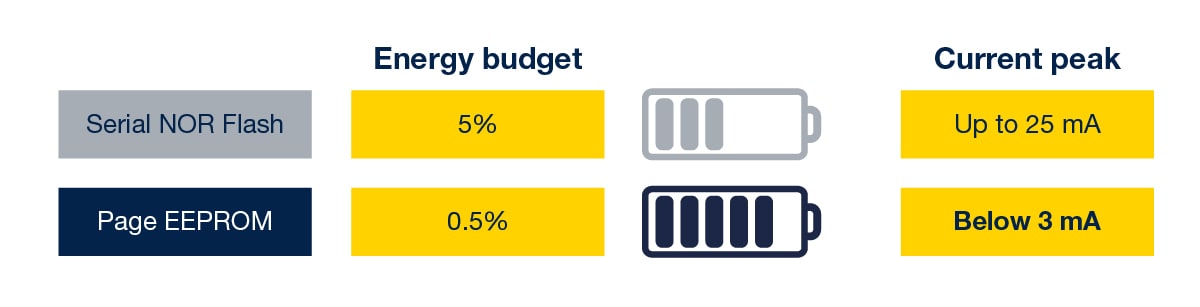
See how much you can save power consumption
See how little power the Page EEPROM consumes in a temperature sensor, watch our live demo for more details about this use case.
Elevate your next IoT application

Smart homes
Smart thermostats, smart locks, smart sensors

Asset tracking
Fleet management, asset monitoring tags, cold-chain trackers

Smart metering & industrial IoT
Smart meters, environmental sensors, industrial wireless sensors
Start prototyping

Page EEPROM memory expansion board
Page EEPROM memory expansion board
Design your next application with the X-NUCLEO-PGEEZ1 expansion board based on the M95P32 SPI Page EEPROM. The expansion board can be plugged on top of STM32 Nucleo boards (via ZIO and Arduino® UNO R3 connectors).