
Drive smarter motor designs with the 75 V STSPIN series
High-power 48 V motor drivers for robotic designs
Revolutionizing motor-drive architectures with high power density and control
Reduce design complexity without compromising flexibility. STSPIN9P1 and STSPIN9P2 help engineers develop compact, high-power 48 V motor-control systems for humanoid and industrial applications. They integrate power MOSFETs with gate-driving and control functions in a single device. With solutions for brushed DC, brushless DC, and stepper motors across a 7 V to 75 V motor-supply range, designers can streamline development, reuse proven designs, and address a broad range of robotic and industrial applications.

One portfolio. Two bridge topologies.
One portfolio. Two bridge topologies.
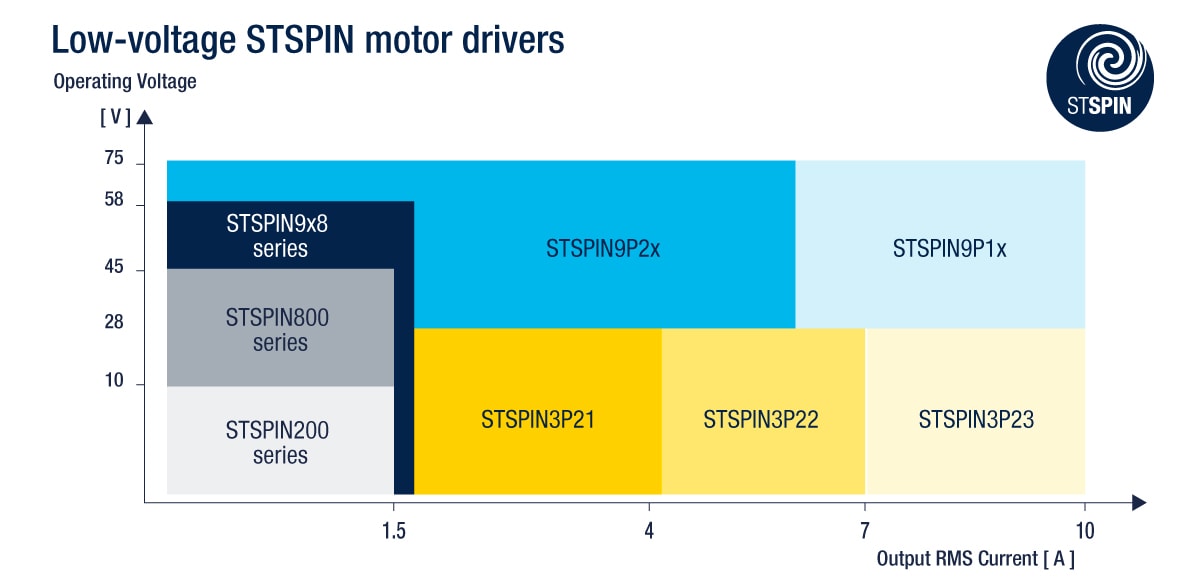
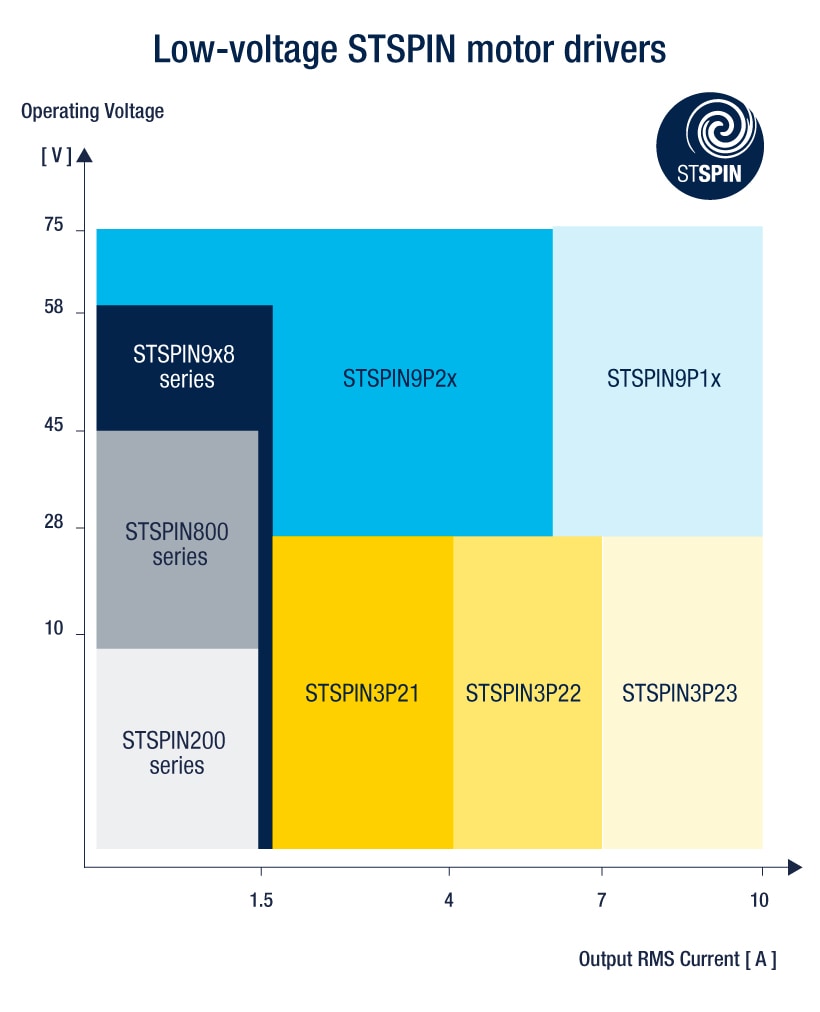
From compact multi-phase motor systems to bidirectional brushed DC and stepper applications, the STSPIN9P portfolio lets you choose the topology that best fits your needs. Choose STSPIN9P1 half-bridges to scale your power stage with options up to 10 A RMS, or STSPIN9P2 full-bridges for bidirectional motor control up to 6 A RMS. Both families support 7 V to 75 V motor supplies and integrate power MOSFETs in compact packages, helping reduce board space and simplify motor-drive design.
Modular flexibility for advanced robotic systems

AGV traction wheels and high-load joints

Robotic joints (shoulders, knees, elbows)
Grippers and precision-motion actuators
Overcome 48 V system design challenges
| What it means | STSPIN solution | Key benefit |
|---|---|---|---|
| Supply transients in 48 V systems | Regenerative braking and switching can cause motor-bus voltage spikes. Peak voltage depends on operating conditions. | 7 V to 75 V recommended motor-supply range. Check worst-case transients and provide system-level clamping where needed. | Supports 48 V system designs, with transient performance validated at the application level. |
| Thermal dissipation in tight spaces | High currents in compact robotic joints lead to overheating and EMI issues. | Low RDS(on) and adjustable slew rate help manage conduction losses and tune switching behavior. | Supports compact power-stage designs. Thermal performance depends on the complete application and its operating conditions. |
| Complex current sensing circuitry | External op-amps add cost, noise, and components to current-feedback loops. | Integrated differential current-sensing amplifier. | Helps simplify the PCB layout and reduce external component count. |
Smart high-power solutions: choose your ideal driver
Core performance features for 48 V systems, designed for complex robotics, humanoid joints, and AGV traction wheels.

STSPIN9P1
75 V high-current half-bridge motor drivers, available with 10 A RMS and 16 mΩ typ. MOSFETs or 6 A RMS and 27 mΩ typ. MOSFETs. Combine half-bridge devices to build motor-drive stages suited to your application.

STSPIN9P2
75 V high-current full-bridge motor drivers for brushed DC or stepper applications. A compact solution for bidirectional motor control with integrated power MOSFETs and a 6 A RMS current rating.
From concept to prototype in three steps
- EVLSPIN9P1x series: dual half-bridge evaluator for brushed DC or BLDC setups.
- EVLSPIN9P2x series: full-bridge evaluator for bidirectional DC or stepper applications.
- EVLSPIN9P1-3PH: 3-phase driver board for BLDC/PMSM configurations.
- For Brushed DC: use STSPIN Studio to configure speed, driving modes, and PWM frequencies.
- For 3-Phase BLDC/PMSM: use X-CUBE-MCSDK with Motor Control Workbench and Motor Pilot for code generation and real-time debugging.
- ST eDesignSuite: upload layout files to simulate thermal behavior and assess PCB design choices before ordering physical boards.
- Use the STSPIN9P device specifications to support thermal analysis and PCB design optimization.

Get started with three-phase motor control
Get started with three-phase motor control
Start your evaluation with the EVLSPIN9P1-3PH board for three-phase BLDC/PMSM motor-control designs based on the STSPIN9P12. Explore the product page and board documentation to evaluate features, operating conditions, and compatibility with your development environment.