Cleaning up the flash memory in interrupt or polling mode
Cleaning up the flash memory in interrupt or polling mode
Once the valid elements are transferred to a new set of pages, the previous set of pages needs to be erased. The EEPROM emulation driver raises a flag requesting the main application to clean up the flash memory. This clean up can be delayed by the application program until the real time constraints on the application are lowered (for instance, before going to low power mode).
This flash memory cleanup can be done in polling mode (by calling the EE_CleanUp function) meaning that the cleanup function does not return before one set of flash memory pages used for EEPROM emulation is erased. It can also be done in interrupt mode (by calling the EE_CleanUp_IT function) meaning that the cleanup function returns immediately and following page erases are done by subsequent interrupt service routines.
Cache coherency maintenance
For most STM32 microcontroller series, the flash memory content is not intended to be modified while the application is running. Thus, on some STM32 microcontrollers, if flash memory data is cached and then modified, this modification is ignored by the cache, and its content becomes incoherent (the data in the cache is different to its new value in flash memory). The X-CUBE-EEPROM firmware implements code to keep the caches coherent so that the user can activate the caches as they wish (instruction cache, data cache, prefetch buffer and so on. Refer to your product reference manual to see which cache is proposed).
For example, for the STM32L5 series X-CUBE-EEPROM example, the MPU (memory protection unit) is used to define the EEPROM flash memory area as noncacheable. Another example is the STM32L4 series, where the DCACHE is flushed after page-erasing operations, as is advised by its reference manual.
API and application examples
EEPROM emulation software description
This section describes the driver implemented for EEPROM emulation using the STM32Cube firmware for your device series, provided by STMicroelectronics.
Key features
User-configured EEPROM size.
Supports 8-bit, 16-bit, 32-bit (and 96-bit variables on the STM32U5 and STM32H5 series).
Increased EEPROM memory endurance versus flash memory endurance.
Wear-leveling algorithm.
Possible interrupt servicing during program and erase operations.
Robust against asynchronous resets and power failures.
Optional protection implementation for flash memory sharing between cores in multicore STM32 devices (for example STM32WB series products).
STM32Cube expansion software (X-CUBE-EEPROM)
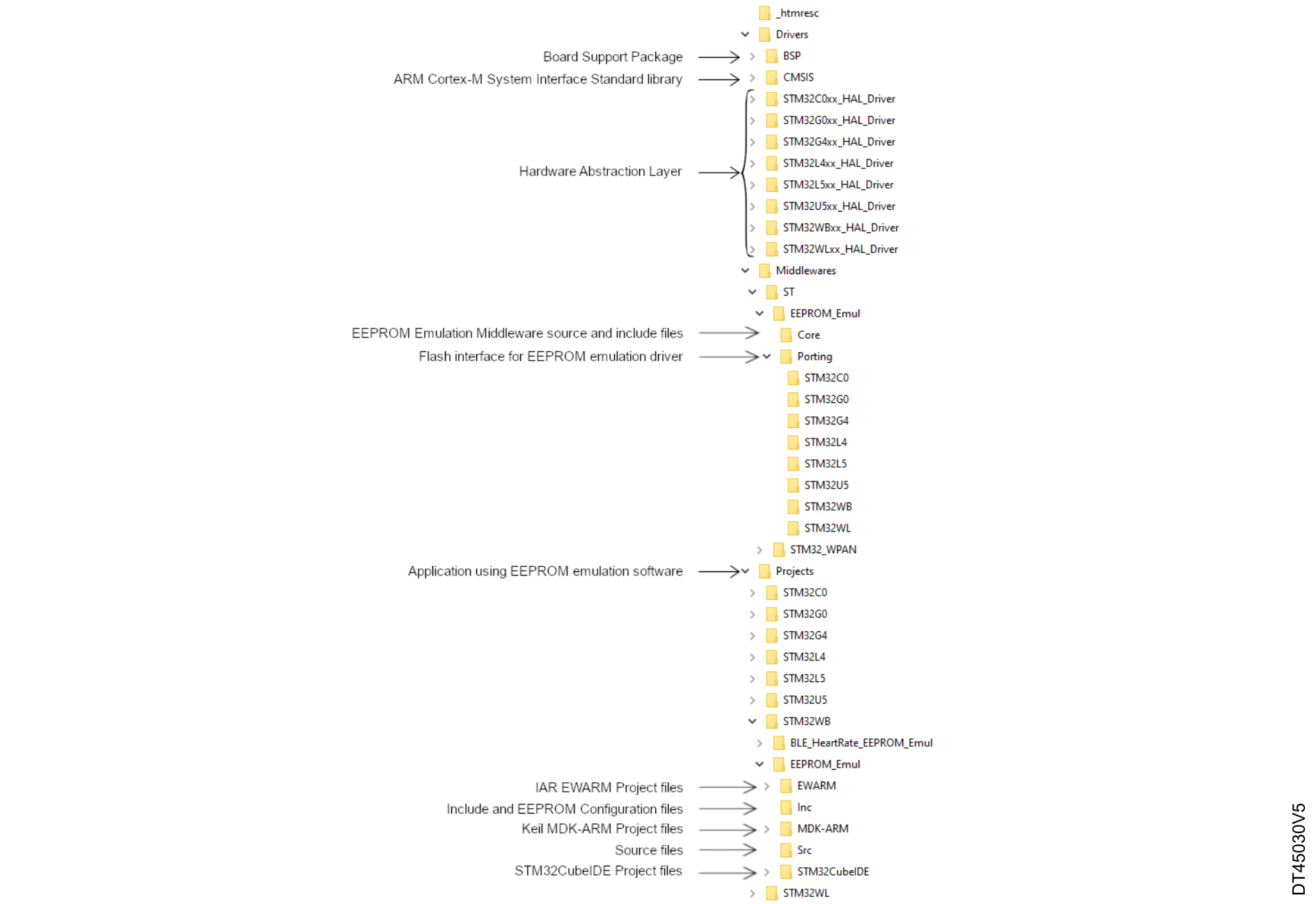
The EEPROM emulation software is provided as a dedicated software package called X-CUBE-EEPROM. It is classified as a middleware utility to be compliant with all development boards and product series.Figure 6. Directory tree
A sample demonstration project using the EEPROM emulation driver is also supplied to demonstrate how to manage 1000 nonvolatile variables. Sample projects are provided for the boards listed in Table 7 Boards covered. They are located in the Projects\STM32xx\EEPROM_Emul package folders, and can easily be tailored to other boards using the same STM32 MCU series.
One more example is provided for the P-NUCLEO-WB55.Nucleo board. It is located at Projects\STM32WB\BLE_HeartRate_EEPROM_Emul\P-NUCLEO-WB55.Nucleo. The Nucleo board maintains a Bluetooth® LE connection and communication in addition to processing EEPROM operations. By using the DUALCORE_FLASH_SHARING preprocessor-defines symbol, this example follows the flash memory sharing mechanism and timing rules described in Dual core considerations.
Table 7. Boards covered
STM32 series
Boards covered
STM32L4 series
STM32L476G-Discovery
STM32L4+ series
STM32L4R5ZI_Nucleo
STM32L5 series
NUCLEO-L552ZE-Q
STM32G0 series
NUCLEO-G071RB
STM32G4 series
NUCLEO-G431RB, NUCLEO-G474RE
STM32WB series
P-NUCLEO-WB55
STM32WL series
NUCLEO-WL33CC1, NUCLEO-WL55JC
STM32U0 series
NUCLEO-U031R8
STM32U3 series
NUCLEO-U385RG-Q
STM32U5 series
NUCLEO-U575ZI
STM32C0 series
NUCLEO-C031C6
STM32H5 series
NUCLEO-H563ZI
The project contains four source files:
eeprom_emul.c: contains the EEPROM emulation firmware functions that can be called from the user program:
flash_interface.c: contains the functions needed to handle the STM32 flash specific features.
main.c: this application program is an example using the described routines to configure, write to, and read from the emulated EEPROM.
stm32xxxx_it.c: shows an example of interrupt service file using the EE_DeleteCorruptedFlashAddress function in the NMI handler.
For the Bluetooth® LE STM32WB series example, BLE_HeartRate_EEPROM_Emul, the code illustrating the driver exploitation can be found in the Core/Src/app_entry.c file. In particular, the functions EEPROM_Emul_Init and EEPROM_Emul_Operation are examples of sequencer tasks for EEPROM driver initialization and exploitation (read and write operations).
User defines
The EEPROM emulation algorithm parameters need to be configured according to the application needs.
They are located in the eeprom_emul_conf.h file:
NB_OF_VARIABLES (default 1000, 100 for STM32C0 series(a)): Number of nonvolatile elements, each element value being 8-, 16-, 32-or 96-bit.
START_PAGE_ADDRESS: Address of the first flash memory page used for EEPROM emulation. For dual-bank capable devices, the first address of the second bank is a good example value for this parameter to benefit from this feature (see Real-time considerations).
CYCLES_NUMBER (default 1): The number of kcycles, X, for the equivalent EEPROM endurance. If CYCLES_NUMBER equals 10, the emulated EEPROM has an equivalent endurance of 10 x X kcycles. X is the flash memory endurance for the product used and listed in Table 5 Flash memory endurance.
GUARD_PAGES_NUMBER (default 2): Number of guard pages used to reduce pressure on flash memory. This number has to be even.
CRC_POLYNOMIAL_LENGTH (default 16): No need to modify in most cases.
A 16-bit CRC is optimized in terms of computational speed and flash memory size, and offers a very good detection rate.
CRC_POLYNOMIAL_VALUE (default 0x8005): No need to modify in most cases.
This ANSI CRC is optimized in terms of computational speed and flash memory size, and offers a very good detection rate
To activate the dual-core flash memory sharing mechanism in the context of the Bluetooth® LE stack of the STM32WB series, DUALCORE_FLASH_SHARING must be defined as a preprocessor symbol in user software.
User API definition
The set of functions that can be called by the applicative program are described in Table 8 API definition. They are defined in the eeprom_emul.c module.
Table 8. API definition
Function name
Description
EE_Format
Erases all flash pages used for EEPROM emulation and writes an ACTIVE header to the first page.
EE_Init
Configures the EEPROM emulation variables to their initial state and restores the flash pages to a known good state in case of asynchronous reset or power loss during flash memory write or erase operation.
Erases the flash pages that need to be erased (for instance pages not fully erased in ERASE state, pages in ERASING state). The EE_FORCE_ERASE parameter has to be used by default. If the application guarantees that no asynchronous reset nor power loss can happen during flash write or erase operations, then the EE_CONDITIONAL_ERASE parameter can be used. Refer to Page header recovery.
After reset, this function needs to be systematically called prior to accessing the emulated EEPROM.
EE_ReadVariableXXbits
This function updates the data value corresponding to the virtual address passed as a parameter. Only the last stored element is read. It returns a status equal to EE_OK unless it cannot find any data at the given virtual address.
Three functions are implemented to deal with all supported data sizes (XX = 8, 16, 32 or 64).
EE_WriteVariableXXbits
This function updates the EEPROM at a given virtual address with the data value passed as parameters.
If the set of pages used for EEPROM emulation is full, it triggers a flash memory page transfer and returns a Status equal to EE_CLEANUP_REQUIRED. In the case of the Bluetooth® LE application for the NUCLEO-WB55 Nucleo board (DUALCORE_FLASH_SHARING is defined), it can return EE_FLASH_USED when the flash memory is used by CPU21
Three functions are implemented to deal with all supported data sizes (XX = 8, 16, 32 or 64).
EE_CleanUp
Erases the set of pages in ERASING state. The application program can call this function when real-time constraints are low. The flash cleanup is done in polling mode so this function does not return before one set of flash memory pages used for EEPROM emulation is erased.
EE_CleanUp_IT
Erases the set of pages in ERASING state. The flash cleanup is started in interrupt mode so this function returns immediately and following page erase is done by subsequent interrupt service routines.
FI_DeleteCorruptedFlashAddress
This function can be called under NMI to delete a corrupted flash address found by the flash memory ECCD in order to clear this flash interface fault Data recovery.
1EE_WriteVariableXX bits can return EE_FLASH_USED only in the case of direct EEPROM variable writing and not in the case of a page transfer, a page header update, or the initialization process. Also, when this value is returned, the driver can activate the HSEM interrupt so that an interrupt is raised when the CPU2 releases the semaphore associated to the flash memory device being used. The user program can then do something else while waiting for the semaphore release.