The CSS is designed to detect a failure of an external clock source (a crystal for example). A loss of clock source is intentional or not. In any case, the device must take appropriate actions to recover. The CSS triggers an interrupt to the core in such event.
If the external clock source drives the main system clock, the CSS switches the system to an internal clock source.
When to use the CSS
The CSS must be used when an external clock is used.
Note:
The CSS is available on all STM32 devices.
Power monitoring (PVD)
Some attacks target the MCU power supply to cause errors that lead to a failure of security countermeasures. A loss of power supply sometimes denotes an attempt to freeze the device state in order to access the internal memory content.
The STM32 devices embed a programmable voltage detector (PVD) that can detect a drop of power. The PVD allows the configuration of a minimum voltage threshold, below which an interrupt is generated, so that appropriate actions are implemented.
When to use the PVD
The PVD must be used as soon as a sensitive application runs, and is likely to leave some confidential data in the working memory (SRAM). A memory cleaning can be launched in case of power down detection.
Note:
The PVD is available on all STM32 devices.
Memory integrity hardware check
The error code correction (ECC) and parity checks are safety bits associated to the memory content:
The ECC is associated to the memory words, used to recover from a single-bit error, or to detect up to two erroneous bits on each flash memory or SRAM word (32- to 256-bit word depending on the memory type). Refer to the AN5342 for more details.
A simple parity check allows the detection of a single error bit on the SRAM words where ECC is not implemented.
When to use ECC and parity check
ECC and parity checks are mostly used for safety reasons. The ECC can also be used to prevent some invasive hardware attacks.
Note:
This integrity protection is available on all devices except STM32F1 and STM32L1. STM32H7 devices are champion in ECC protection.
Independent watchdog (IWDG)
The IDWG is a free running down counter that can be used to trigger a system reset when the counter reaches a given timeout value. The IDWG can be used to provide a solution in case of malfunctions or deadlock in running code. The IDWG is clocked by its own independent low-speed clock (LSI), so that it stays active even in the event of a main clock failure.
When to use the IWDG
The IWDG can be used to break deadlocks. It can also be used to control execution time of critical code (such as decryption or flash memory programming).
Note:
The IDWG is available on all STM32 devices.
Device ID
Each STM32 device has a unique 96-bit identifier providing an individual reference for any device in any context. These bits can never be altered by the user.
The unique device identifier can be used for direct device authentication, or for instance to derive a unique key from a master OEM key.
Cryptography
As described in Secure applications, cryptography is essential to secure an embedded system. The cryptography enables confidentiality, integrity, and authentication of data or code. For efficiently supporting these functions, most STM32 series include products with hardware cryptography peripherals. These peripherals allow cryptographic computations (such as hashing or symmetric algorithms) to be accelerated. For devices with no such specific hardware acceleration, the STM32 cryptographic firmware library (CryptoLib) provides a software implementation of a large set of cryptographic algorithms.
The cryptography related features for each product can be identified via their root part number, specifically on the second number or letter after the series identifier. For example the STM32L486 and STM32H7B3 devices have crypto hardware while the STM32L476 and STM32H7A3 have to use software library to implement cryptography, and it can be known by their naming.
True random generator (TRNG)
The ability to generate unpredictable numbers with appropriate statistical properties is essential for cryptographic security. Most STM32 MCUs feature a hardware-based peripheral based on a physical noise source. It can be used to feed a DRNG with a seed, or directly for random numbers, depending on device. Depending on the device, it can be used to seed a DRNG or to generate random numbers directly.
Note:
For more details about the RNG validation, refer to the application note "Introduction to random number generation validation using the NIST statistical test suite for STM32 MCUs and MPUs" (AN4230).
AES accelerator (AES/SAES)
The AES is an industry-standard symmetric encryption and decryption algorithm.
The base peripheral improves AES efficiency by providing hardware support for various block and chaining modes, such as ECB, CBC, CTR, and GCM, as well as for different key lengths and DMA operation. Its main advantages are faster processing and lower power consumption. However, developers must still pay close attention to key management to maintain security.
When AES is used for encryption or decryption, access to the registers containing the key must be protected, and the key material must be erased after use. The MPU can be configured to restrict access to memory containing keys.
SAES provides a higher level of security, partly because its computation is obfuscated to resist more advanced side-channel attacks and partly because, when DHUK is used, the actual encryption key can be hidden so that it never appears in addressable memory in plain form. On applicable devices, SAES can also use keys directly from OBK.
Public key accelerator (PKA)
This coprocessor provides acceleration of RSA, DH, and ECC operations over GF(p), based on the Montgomery method for fast modular multiplications. Built-in inward and outward transformations in the Montgomery domain are used to implement the operations required by asymmetric cryptographic algorithms.
The operands are loaded into dedicated memory, and the hardware performs the requested transformation. As with the symmetric cryptography accelerator, the main security concern is that the software must handle key storage and copying.
Coupling and chaining block (CCB)
This feature can be used to wrap an RSA or ECC private key and perform an electronic signature or decryption with greater security, as the private key is not exposed to the CPU during use. As in SAES, DHUK is used for wrapping, and OBK is available for key storage. For more information, refer to AN6205.
HASH processor (HASH)
This cryptographic peripheral produces a digest of data. Supported algorithms are MD5, SHA-1, SHA-2, and SHA-3. SHA-3 support is limited to the newest products.
The peripheral also supports DMA, which further offloads the CPU.
CryptoLib software library
The STM32 X-CUBE-CRYPTOLIB software library runs on all STM32 devices. It is available for free download at www.st.com/en/product/x-cube-cryptolib. The version V4 is available with full firmware implementation, compiled for Cortex‑M0, Cortex‑M0+, Cortex‑M3, Cortex‑M33, Cortex‑M4, and Cortex‑M7.
The X-CUBE-CRYPTOLIB supports the following algorithms:
ECC with key generation, scalar multiplication (basis of ECDH) and ECDSA + ED25519 and Curve 25519
On-the-fly decryption engine (OTFDEC)
The external memory content (code and data) cannot be protected with traditional read/write protections. The way to protect the content is to encrypt and decrypt it inside the device before using it.
One solution is to download the external memory content inside the SRAM, to decrypt it, to execute the code, and/or to use data. There are two drawbacks with this method: it introduces a delay that may not be acceptable, and it uses a large amount of SRAM, depending on the content.
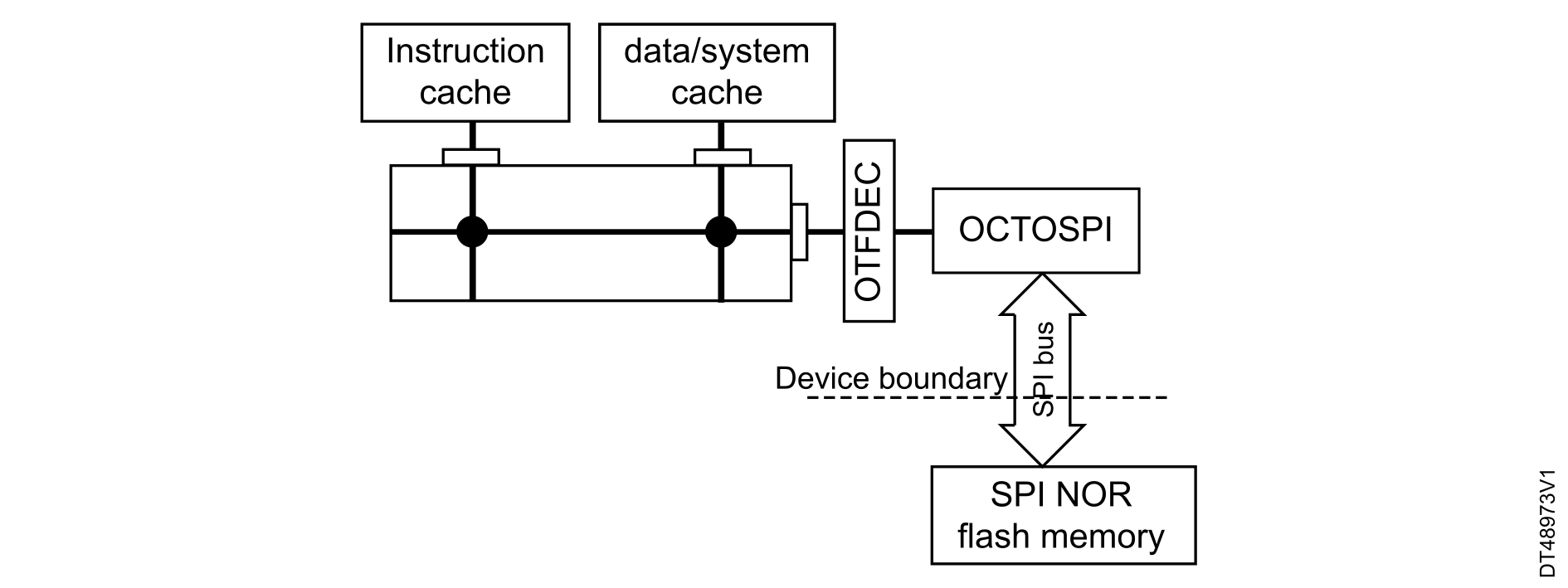
The OTFDEC peripheral offers the possibility to decrypt the content directly with a low-latency penalty, and without the need for SRAM allocation. The OTFDEC decrypts the on-the-fly bus traffic based on the read-request address information. It is used with the Octo-SPI interface (see the figure below).
Figure 14. Typical OTFDEC configuration
The OTFDEC uses the AES-128 CTR mode, with a 128-bit key to achieve a latency below 12 system bus cycles. Up to four independent and nonoverlapping encrypted regions can be defined (4-Kbyte granularity), each with its own key.
When to use the OTFDEC
The OTFDEC is used when an external memory is used by the system. For TrustZone® capable MCUs, the decryption keys can only be made accessible through the secure mode. See the application note How to use OTFDEC for encryption/decryption in trusted environment on STM32H73/H7B MCUs (AN5281) for more details.
Note:
The OTFDEC is available on STM32H5, STM35H7, STM32L5, and STM32U5 devices only.
Memory crypto engine (MCE)
The memory crypto engine feature replaces the OTFDEC in selected products, specifically those with limited internal memory and designed to use mainly external memory.
The differences are summarized in the following table.
Table 17. Features of the OTFDEC compared with the MCE
Feature
OTFDEC
MCE
Function
On-the-fly decryption
Encryption and decryption
Algorithm
AES-based stream + proprietary
AES stream, AES block, DPA resistant
Key management
128b key per region, TZ protection, write only
Similar, usually tied to OBK by the software logic