Matter is an open-source standard designed to support seamless interaction between IoT devices in smart homes and smart buildings. Hosted by the Connectivity Standards Alliance (CSA), it helps devices from different brands communicate smoothly and securely, while supporting data privacy.
At the application level, matter simplifies adoption by covering a wide range of use cases through an open-source delivery model, backed by a certification infrastructure.
Matter gives developers a common foundation to build interoperable connected products with a clearer path to deployment.


Applications
_Elisa%20CAPPELLETTI%20(1).png "Lightingwireless control")



The roles of connected devices in a Matter network
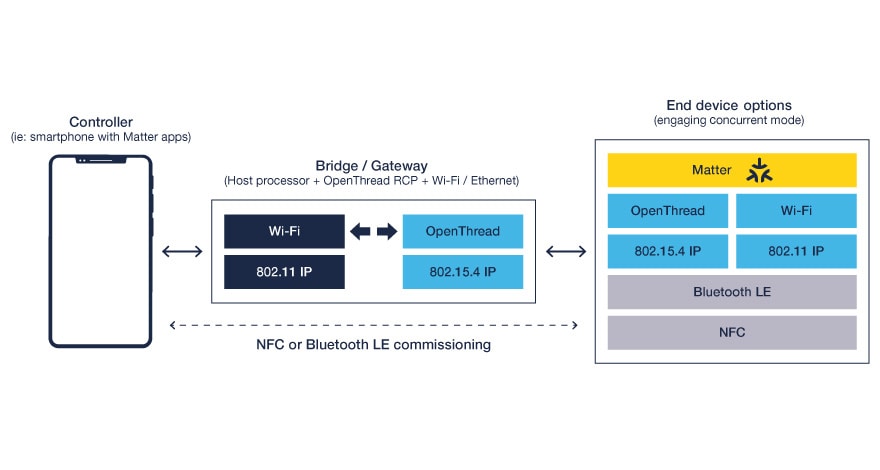
In smart homes, connected devices run based on Wi-Fi, Thread or Ethernet technologies, and each device has a specific role within the Matter network.
Such devices also need to support commissioning, the process of adding a new device to an existing Matter network. Device commissioning can be done via Bluetooth® Low Energy with the help of near field communication (NFC).
.png "Smart home with Matter")
- Matter end devices are the products people use every day, such as lights or temperature sensors. They run the final application, and are connected to the Matter network.
- Routers and bridges help move data where it needs to go. For example, a gateway can take data from an end device and transfer it from one protocol to another, such as from Wi-Fi to Thread and vice versa. Controllers are typically smartphones or tablets used to add an end device to a Matter network. Commissioning starts over Bluetooth® Low Energy or NFC, making setup simple and familiar.
- Users can add a new device to the network by entering a passcode, scanning a QR code, or tapping their smartphone through NFC technology.
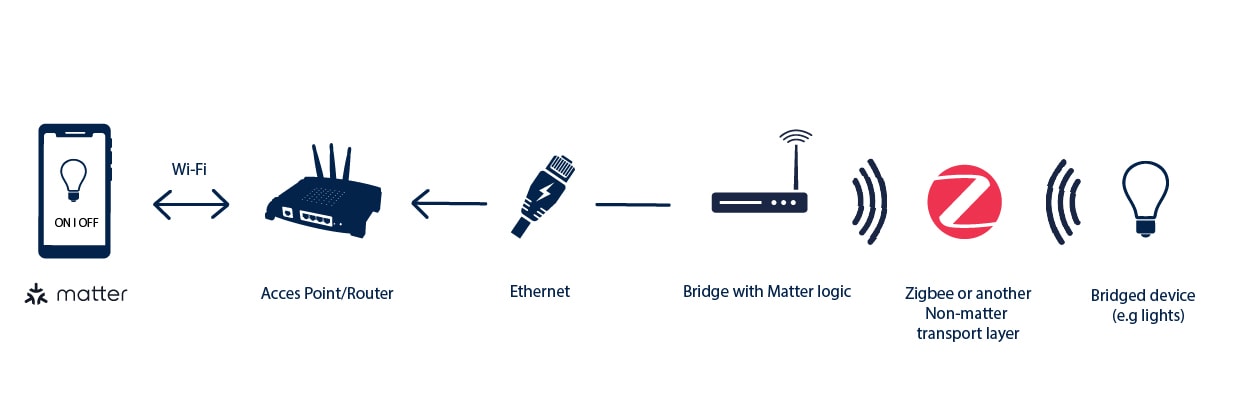
Matter bridge use case
Why use NFC for device commissioning?
As a widespread technology already integrated into most smartphones, NFC is an intuitive and reliable solution for onboarding, which streamlines the commissioning experience. Since NFC can be completely integrated into devices, it is both robust and discreet.
In addition to device commissioning, NFC can be used to change device parameter settings, enable customer re-engagement tactics, and more.
Why use a Secure Element to attest that devices belong to the Matter ecosystem?
Ensure that a Matter device is genuine and interoperable with a Secure Element that provides manufacturers’ certificates and manages Matter device attestation. STSAFE secure microcontrollers are personalized with the device manufacturer’s credentials and pre-configured with the cryptographic protocol for Matter device attestation. Device manufacturers that use STSAFE can prevent Matter object cloning and Matter object overproduction without having to implement cost-prohibitive or complex security processes during object configuration.
Discover our portfolio
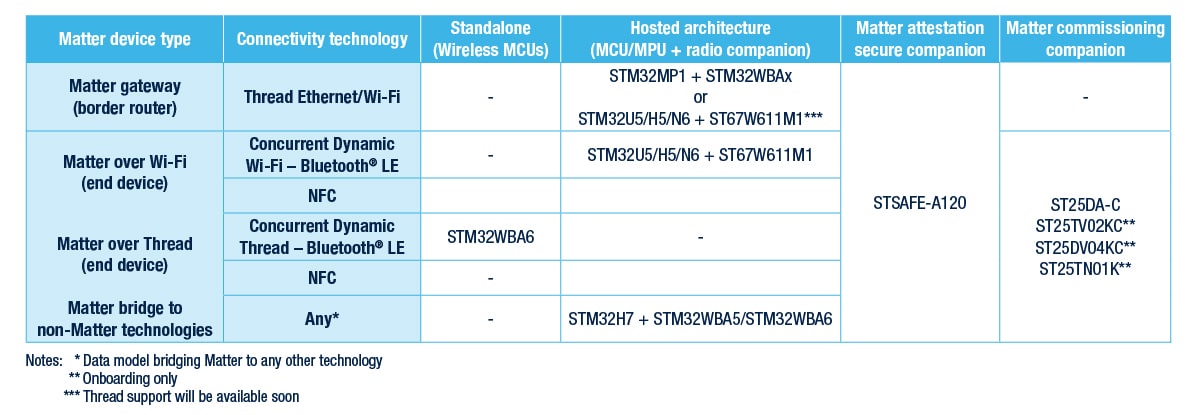
Several ST product families support Matter standard, and are suitable for different device types:
Benefits
- The ST portfolio covers all Matter device types and technologies
- Low-power solutions for battery-operated devices
- Comprehensive ecosystem for rapid development
- Multiprotocol wireless support required for Matter
- Product quality assurance for longevity requirements
ST authorized partner
Discover the full added value of STMicroelectronics' Matter solutions through our partnership with Commscope. By benefiting from their security solutions and services, users can easily and quickly enable secure Matter connectivity and smart home products, thanks to the complete integration of their provisioning client with STM32 MCUs.


STM32 software ecosystem
X-CUBE-MATTER, making Matter development accessible and easy for developers and engineers
With 2-3 releases per year, the Matter SDK integration offers seamless integration with the STM32 family, supporting Matter technologies like Thread, Wi-Fi, and Ethernet.
The SDKs also include Matter functionalities like OTA support, provisioning services, and sleeping end devices. The development environment is available on Linux, Mac, and Windows for broader accessibility.
The reference hardware includes development boards preintegrated with STM32 ecosystem tools, making it easier to prototype and start developing applications.
Online content, and support are available, including a dedicated Wiki site, ST FAE team, and ST Community.
A wide range of application examples are available, including end devices like lighting apps, window coverings, Thread Border routers and Matter-to-non-Matter bridges.
For other applications, please contact our sales office
Additional examples with STM32 MPU demonstrating the Thread border router functionality can be found under Github.
For solutions combining Matter and Wi-Fi, please visit the Wi-Fi product page.
Matter is an open-source standard hosted by the Connectivity Standards Alliance (CSA) that ensures seamless interaction between connected mart home and smart building devices across different IP technologies.
With Matter, multiple brands can interact smoothly and securely while ensuring data privacy, allowing wide adoption through a unified certification infrastructure
Understand the Matter network
A Matter network brings together several types of devices, each with a specific role:
Matter end devices
Connected objects, such as smart lighting, door locks, or sensors, that operate via Wi-Fi, Thread, or Ethernet.
Matter controllers
Devices like smartphones, tablets, or smart hubs that commission (onboard) and manage devices on the network.
Thread border routers and Matter bridges
Gateways that connect different networks: Thread border routers route Thread traffic to Wi-Fi or Ethernet networks, while Matter bridges bring non-IP devices into a Matter network.
Step 1: Choose your connectivity products
Click on the architecture that best suits your project to find the appropriate boards.
Choose the STM32U5/N6/H5 and add the ST67W611M1 to bring Matter to mains-powered, always-connected devices.
- Architecture: The STM32 host runs the Matter application using X-CUBE-MATTER, while the ST67W611M1 manages the operational Wi-Fi connection.
- Commissioning: Integrated Bluetooth® Low Energy is built into the ST67W611M1, so device onboarding works without a second radio.
- Design flexibility: Add Matter over Wi-Fi to an existing STM32 design without moving to a single connectivity SoC.
- Scalability: Pair the module with STM32 devices ranging from low-power to high-performance series: STM32U5 / STM32N6 / STM32H5
Choose your STM32 based on the role your product plays in the Matter over Thread network: a low-power end device or a gateway that connects Thread devices to the wider IP network.
- For low-power Matter end devices: use the STM32WBA6 MCU. Its low-power design and built-in radio allow it to run Thread and Bluetooth® LE concurrently: Bluetooth® LE is used for pairing, while Thread carries everyday device communication on the operational network.
- For a Thread border router or gateway: use the STM32MP1 together with the STM32WBA5 MCU as a radio coprocessor. This architecture makes Thread devices reachable from the smart-home IP network, so they can be commissioned, controlled, and used through Matter.
When your Matter design needs to communicate with a non-Matter network, such as Zigbee or LoRa, you need a bridge. Use the Ethernet-enabled STM32H7 MCU to translate data between the two ecosystems.
Step 2: Add your Matter onboarding and commissioning method
Click to create the Matter onboarding experience your project needs.
Bluetooth® LE is the standard wireless commissioning method by default for Matter. It lets a Matter controller, such as a smartphone or tablet, discover and onboard a Matter device. Bluetooth® LE is already included in the ST67W611M1 and STM32WBA, so no separate radio is needed. Ethernet being the single case where Bluetooth LE is not mandatory, otherwise required to be compliant and an additional means like NFC can be part of the commissioning strategy.
Make Matter onboarding intuitive with the optional ST25DA-C NFC chip.
NFC benefits:
- Convenient: Start the process with a single smartphone tap, no need to find a QR code.
- No power required: Ideal for installers commissioning unpowered devices.
- Secure credentials: The ST25DA-C embedded secure element protects sensitive Matter credentials.
- More value after installation: The ST25DA-C supports additional use cases, such as updating settings or accessing product services.
Step 3: Bring your project to life with our Matter software
X-CUBE-MATTER is our Matter software development kit. It supports key Matter capabilities, including over-the-air updates, provisioning services, and sleeping end devices. Available for Linux, macOS, and Windows.
Get started with STM32 development boards and ready-to-use X-CUBE-MATTER examples in STM32Cube.
Build from application examples, then adapt the closest example to your own design. An additional STM32 MPU project on GitHub demonstrates Thread border router functionality.
Need an example for another device type? Ask us through the ST Community or read our STM32 Wiki, get step-by-step guidance from prototyping to certification.
Step 4: Certify your Matter device
Certification is critical. Completing the Connectivity Standards Alliance (CSA) certification proves that a device complies with the Matter standard. ST makes the certification process easier with Matter-certified platforms:
- Matter over Wi-Fi (CSA certificate)
- Matter over Thread (CSA certificate)
Step 5: Give every Matter device a trusted identity
Before a device can join a Matter network, it must prove that it is genuine and certified. You must therefore provision each device with unique Matter credentials. These credentials help protect the Matter network from unauthorized or cloned devices.
To prove that each Matter device is genuine and interoperable, you need to generate a unique Device Attestation Certificate and private key, provision them securely, and manage their lifecycle. You have three options to source your Matter credentials:
- Do it on your own: Generate, provision, and maintain credentials using your own Matter-authorized public key infrastructure.
- Use Aurora networks for STM32 MCUs: Choose this option to provision Matter credentials directly on an STM32 MCU. Our ST partner Aurora Network (former CommScope) provides a provisioning client integrated with STM32, along with the PKI infrastructure and services needed to generate, deliver, and manage credentials across your device lifecycle.
- Use ST MatterConnect for ST secure companion chips: Choose this option when your design includes an eligible ST secure companion chip, such as ST25DA-C or STSAFE-A. ST generates and provisions the Matter credentials into the secure hardware at its secure manufacturing sites, so private keys remain isolated from the STM32 application processor. Learn more about ST MatterConnect.
Frequently Asked Questions
Matter is an open standard for smart home devices. It is designed to let devices from different brands work together more easily through a common language and a secure connection model. Matter helps simplify setup, control, and compatibility across ecosystems such as voice assistants, smartphone apps, and smart home platforms.
Matter works by defining a common application layer and set of device behaviors that supported products can use to communicate. Devices can connect through local networks such as Wi-Fi, Ethernet, or Thread, and they are commissioned securely into a smart home ecosystem using standard procedures. Once connected, Matter-enabled devices can be controlled by compatible apps and controllers from different manufacturers.
A Matter smart home is a home where connected devices — such as lights, switches, plugs, thermostats, sensors, locks, and more — use the Matter standard to work together across brands and platforms. This makes it easier to build a smart home that is more interoperable, easier to install, simpler to manage and maintain.
Choose Wi-Fi for mains-powered devices that need direct network access, higher data throughput, or cloud connectivity. Choose Thread for battery-powered or low-data-rate devices that benefit from low-power mesh networking. Also consider the existing installation: Matter over Thread requires a Thread border router, while Matter over Wi-Fi connects through a standard Wi-Fi access point.
Not always. Matter over Wi-Fi devices use the existing Wi-Fi router or access point. Matter over Thread devices need a Thread border router to connect the Thread mesh to the home or building IP network. This capability may already be built into a compatible smart-home hub, speaker, or Wi-Fi router, so check the target ecosystem before adding dedicated hardware.
Often, yes. A hosted architecture can keep the application on the existing STM32 while adding the connectivity required for Matter. Developers should first verify memory, interfaces, security, and over-the-air update requirements.
Download our guide to select the board that matches the target transport and architecture, then begin with the X-CUBE-MATTER example closest to the intended Matter device type. Validate the example unchanged before adapting clusters, application logic, and hardware.
Confirm that the reference example builds, commissions, joins the operational network, exchanges commands, and reconnects correctly. This provides a known baseline before product-specific development begins. Read our complete guide to learn more.
Define it early because it affects hardware, enclosure design, user interaction, manufacturing data, and testing. Consider device accessibility, whether it is powered during onboarding, and whether Bluetooth LE only, or Bluetooth LE + NFC best fit the installation journey.
Plan them before production architecture is frozen. Credential storage, PKI ownership, provisioning, factory processes, and certificate lifecycle management can influence hardware selection and manufacturing operations. ST offers a credential service with ST MatterConnect for ST25DA-C or STSAFE-A and through an Authorized Partner for STM32s with Aurora networks.
Test commissioning, removal and recommissioning, network loss and recovery, incorrect credentials, over-the-air updates, low-power behavior, and interoperability with the targeted ecosystems. ST Matter validation flow integrates interoperability testing with Matter ecosystems.
Typical causes include provisioning errors, network incompatibility, discovery timeouts, incorrect onboarding data, and certificate issues. Diagnose the flow stage by stage: discovery, secure session establishment, attestation, network configuration, and operational discovery.
Plan secure firmware updates, version compatibility, diagnostics, recovery behavior, and regression testing from the beginning. Also define how Matter credentials and certificates will be securely stored, provisioned, revoked if compromised, and recovered over the product lifecycle. ST can support credential provisioning and lifecycle management through ST MatterConnect or its authorized partner, CommScope.