
MEMS vs. traditional sensors: why MEMS is the primary choice for modern design
Sensor technology has played a key role in electronics innovation for decades. Traditional sensors have long been used in applications requiring specialized performance, but the rise of micro-electromechanical systems, or MEMS, has transformed the landscape. By combining sensing elements and electronics in compact semiconductor-based devices, MEMS sensors offer significant advantages in size, power consumption, cost, and scalability.
For most modern applications, MEMS sensors are the natural choice. However, traditional sensors still retain an advantage in certain demanding, niche use cases where ultimate performance is more important than size, power, or cost. This article compares MEMS and traditional sensors across key criteria and highlights the scenarios where each technology is most appropriate.
Defining the technologies: a matter of scale and integration
The most fundamental difference between MEMS and traditional sensors lies in their manufacturing process, which dictates their physical scale and level of integration.
Traditional sensors
These sensors are constructed from discrete, macro-scale components assembled into a functional unit. A traditional gyroscope, for example, might involve a spinning mechanical rotor, gimbals, and separate electronic boards for signal processing.
- Architecture: multi-part, mechanical assembly.
- Size: it ranges from several centimeters to much larger, making them unsuitable for compact applications.
- Manufacturing: machining, manual or semi-automated assembly, and individual calibration of separate parts. This process is often complex and does not scale well, leading to higher per-unit costs.
MEMS sensors
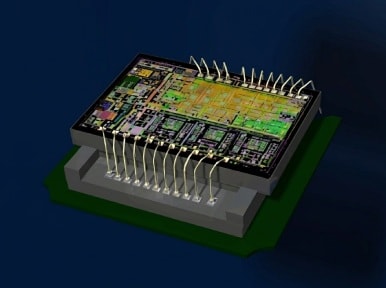
MEMS technology utilizes batch fabrication techniques borrowed from the semiconductor industry to create both mechanical sensing structures and electronic circuits on a silicon wafer.
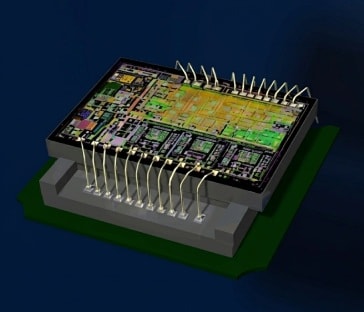
- Architecture: monolithic, solid-state integration. A MEMS accelerometer chip, for instance, contains a microscopic proof mass, springs, and the signal-conditioning ASIC within a single tiny package.
- Size: typically measured in millimeters, MEMS sensors are thousands of times smaller and lighter than their traditional counterparts.
- Manufacturing: millions of sensors are produced simultaneously on a single silicon wafer, dramatically reducing manufacturing costs and ensuring high consistency between devices. This scalability is the primary driver of the widespread adoption of MEMS and sensors.
Technology comparison at a glance
The following table summarizes how structural differences between these sensor types influence design parameters, helping you determine the most effective solution for your specific application requirements.
| Traditional Sensors | MEMS Sensors |
|---|---|---|
| Size & weight | Bulky and heavy. Often a limiting factor in system design. | Extremely small and lightweight (down to 2x2 mm). Enables miniaturization and portability. |
| Power consumption | High. Often requires significant power, unsuitable for battery operation. | Very low. Typically in the microampere (µA) or milliampere (mA) range, ideal for wearables and IoT. |
| Performance | Can offer exceptionally high performance in specific, niche applications (e.g., tactical-grade gyroscopes). | Excellent performance for a vast range of applications, with continuous improvement in noise and stability. |
| Reliability | Susceptible to shock, vibration, and wear due to moving parts and complex assembly. | Highly robust. Solid-state design provides excellent resistance to shock and vibration. |
| Cost | High per-unit cost due to complex assembly and low-volume production. | Low per-unit cost, driven by high-volume semiconductor batch fabrication. |
| Integration | Requires external signal conditioning circuitry, increasing board space and design complexity. | Highly integrated. Includes an ASIC for signal conditioning and digital output in a single package supporting standard communication protocols (I2C, I3C, SPI). |
Application-specific trade-offs: where each technology excels
While MEMS technology has replaced traditional sensors in many areas, there are still specific domains where the legacy technology holds an advantage.
Where MEMS sensors dominate
MEMS sensors’ small size, low power, and low cost, make them the preferred choice for high-volume, space-constrained, and battery-powered applications.

Consumer electronics:
modern smartphones or wearable devices rely on MEMS, which provide motion sensing for screen rotation (accelerometers), step counting, and image stabilization (inertial modules) and pressure sensors supply altitude data for fitness apps.


Industrial IoT (IIoT):
the low cost and small size of MEMS sensors allow for the deployment of thousands of sensor nodes for condition monitoring. MEMS accelerometers can be placed on countless machines to monitor vibrations and enable predictive maintenance, a use case that would be economically unfeasible with traditional sensors.
Where traditional sensors retain a foothold
Despite the advantages of MEMS, some specialized, performance-critical applications require the highest performance, regardless of size, power, or cost.
- Aerospace and defense: strategic-grade inertial navigation systems use fiber-optic gyroscopes (FOGs) and ring laser gyroscopes (RLGs) for bias stability and low noise, essential for long-duration navigation without external updates.
- High-pressure industrial processes: for measuring extremely high pressures (e.g., >10,000 psi) in industrial settings, traditional strain-gauge-based pressure transducers made from robust metals like stainless steel are often more reliable and durable than silicon-based MEMS, which can be more fragile under such extreme conditions.
- Scientific and metrology instruments: laboratory settings requiring ultimate precision may use traditional sensors for a higher degree of accuracy in specific measurements.
Looking ahead: innovations in MEMS sensor technology
MEMS technology is advancing at a rapid pace. Improvements in design and manufacturing are closing the gap with traditional sensors, enabling MEMS to meet demanding application requirements.
- Performance enhancement: advanced MEMS designs, improved materials, and sophisticated ASIC compensation techniques push MEMS performance. High-performance MEMS IMUs now offer stability and noise levels that make them suitable for a wider range of industrial and tactical applications previously dominated by more expensive traditional sensors.
- Embedded intelligence: integration of machine learning core (MLC) and intelligent sensor processing units (ISPU) onto MEMS chips is a capability that traditional sensors cannot match. This on-chip processing reduces system power and complexity and supports smart, autonomous sensing solutions.
Looking ahead: innovations in MEMS sensor technology
MEMS technology is the preferred choice for most modern electronic applications. Advantages in size, weight, power consumption, cost, and reliability have made MEMS a key driver of innovation across consumer, automotive, and industrial markets. While traditional sensors still play a role in certain high-performance niches, their relevance is diminishing as MEMS technology advances. Leveraging modern MEMS technology enables the creation of more compact, intelligent, and powerful systems. This allows engineers to meet the demands of tomorrow’s applications.