
Audio over Ethernet for
software-defined vehicles
Zonal audio distribution over the automotive Ethernet backbone
Explore how ST enables distributed in-cabin audio over an Automotive Ethernet backbone, supporting zonal software-defined vehicle architectures, synchronized audio transport, and reduced wiring complexity.
A new architecture for in-cabin audio
As vehicles move toward zonal and software-defined architectures, audio distribution is no longer limited to dedicated point-to-point cabling. Automotive Ethernet makes it possible to stream audio across a shared backbone, helping simplify system design while supporting scalable in-cabin audio concepts.
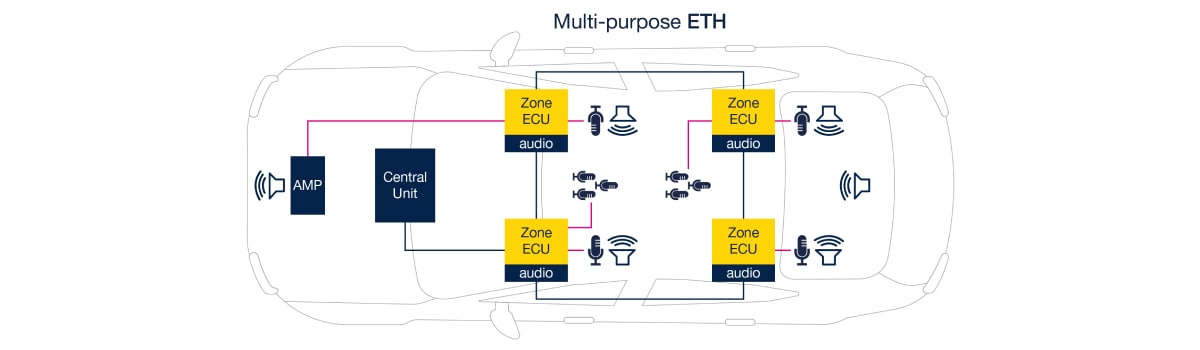
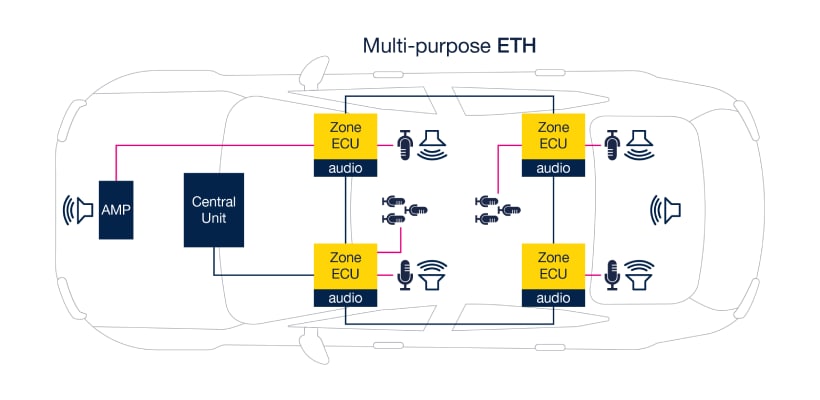
This approach is especially relevant for next-generation vehicles where multiple audio zones, centralized processing, and dynamic software-based feature integration are becoming increasingly common.
The ST Stellar G platform supports this evolution by enabling real-time processing, network integration, and synchronization in distributed automotive systems.
Why traditional audio architectures are becoming harder to scale
Conventional audio architectures often rely on dedicated cables between head units, amplifiers, microphones, and zone controllers. As vehicle platforms grow more complex, this can increase:
- Harness size and routing complexity
- System cost and manufacturing effort
- Synchronisation challenges accros zones
- Difficulty adapting audio functions across vehicle variants
By moving audio distribution onto Automotive Ethernet, OEMs and Tier 1s can align audio functions more closely with zonal vehicle architecture while reducing dependence on dedicated audio wiring.
As vehicle architectures evolve toward a more zonal control, Audio over Ethernet offers a scalable and efficient approach to delivering a premium in-cabin audio experience.
Reference solution for zonal AoE
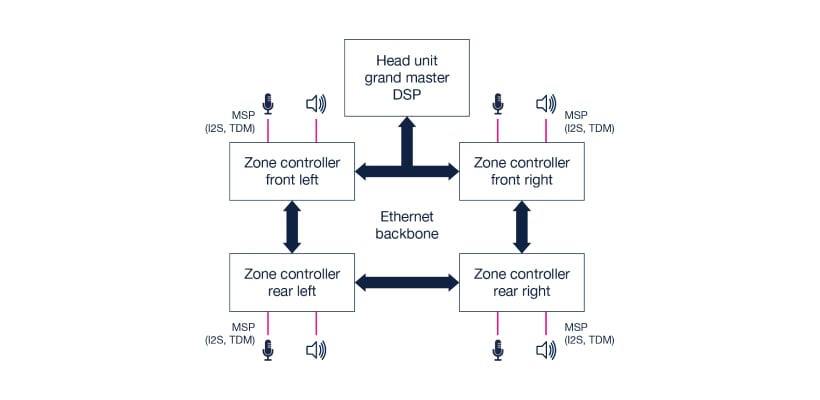
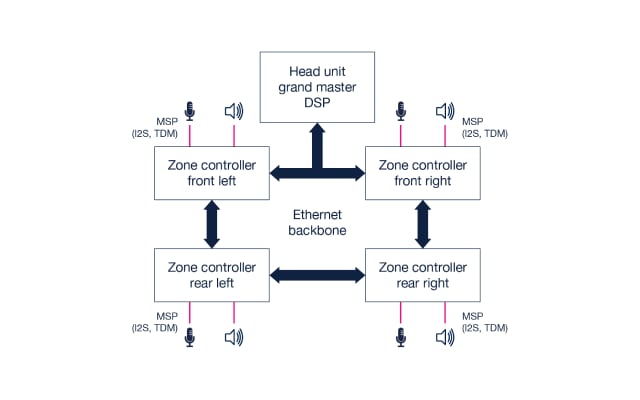
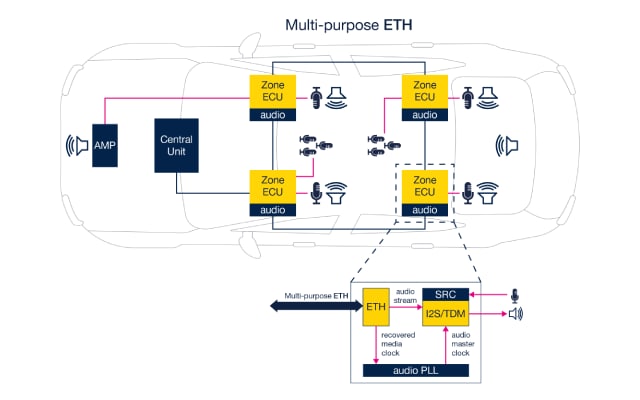
The PoC demonstrates a practical architecture composed of:
- A central unit
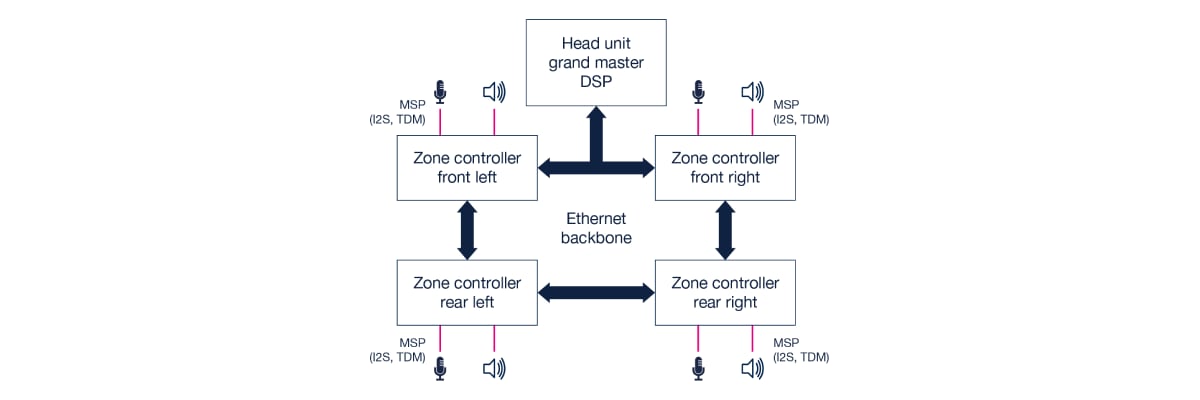
- One or more Zone ECUs / ZCUs connected via an Ethernet backbone
- Audio endpoints, including amplifiers, microphones, AUX inputs, and vehicle sound devices
- Embedded hardware capabilities such as serialized audio transport over MSP, I2S, or TDM, media clock recovery, and node-level synchronization
- Software solutions provided by ecosystem partners
In this configuration, audio streams are transmitted using the Audio Video Bridging (AVB) protocol, which was specifically designed to support high-quality media over Ethernet. By utilizing the synchronization and bandwidth reservation capabilities built into the Stellar MCU, audio data is sent across the Ethernet network and accurately rebuilt at its destination. This ensures precise time alignment and reliable clock recovery for a seamless listening experience
How synchronization and timing
are maintained
Audio transport over Ethernet requires deterministic timing across sources and targets to keep playback aligned and avoid audible delay variations.
The presented PoC is built around synchronized audio streaming using audio transport protocols and network timing mechanisms designed for time-sensitive applications. At the system level, this helps support:
- Synchronized playback across distributed nodes
- Stable media clock recovery
- Low-jitter audio reconstruction
- Consistent audio behavior under varying network conditions
Technology basis :
- IEEE 1722 AVTP for audio transport
- IEEE 802.1AS / PTP for time synchronization
- Ethernet queuing and traffic shaping for time-sensitive streams
What Stellar G6 brings to the architecture
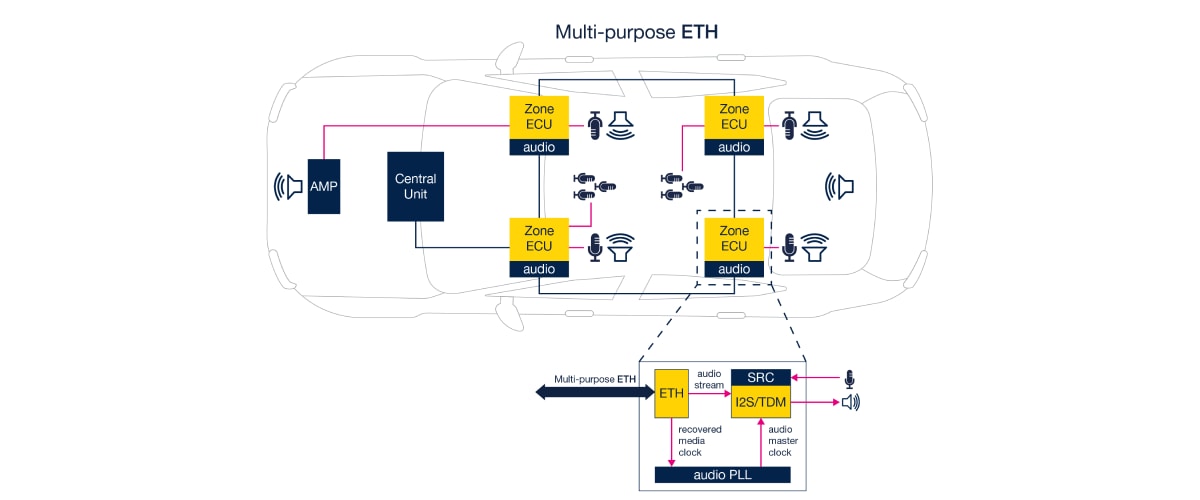
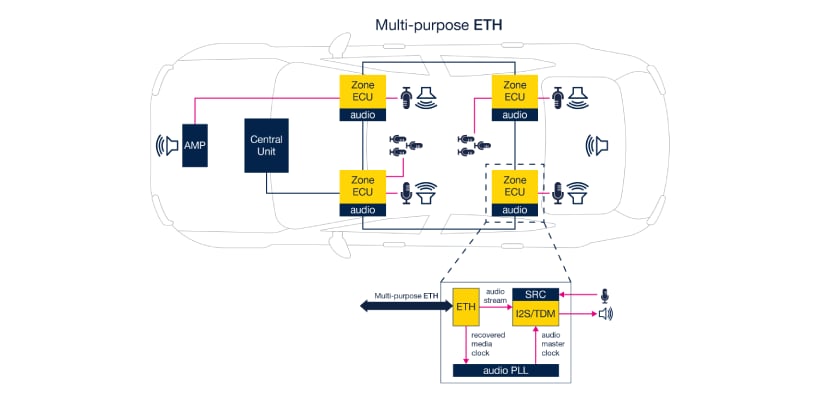
The ST Stellar G6 automotive MCU platform is a strong fit for zonal Audio over Ethernet implementations because it can help integrate:
- Real-time control tasks for zonal applications
- Dedicated ethernet communication
- Media clock recovery
- Audio stream handling
- Synchronization and timing support
- Node-level system coordination
- Native audio interfaces such as I2S/TDM
The platform concept shown in the PoC demonstrates how a Zonal Controller Unit (ZCU) can combine Ethernet connectivity, audio interfaces, and embedded processing to support in-cabin sound concepts in a single node.
Validation and proof of concept
The PoC material demonstrates that Audio over Ethernet can support:
- Distributed in-cabin audio streaming
- Multi-channel audio transport
- Multiple audio endpoints
- Resilient operation during cable plug/unplug trials
- Seemless operation in the presence of system load variation
What the PoC demonstrated
The proof-of-concept (PoC) demonstrated audio transport over Ethernet in a zonal architecture, including synchronized playback, distributed endpoints, and resilience under dynamic operating conditions. The approach highlights how real-time processing, synchronization, and networked distribution can work together to support in-cabin audio across multiple zones.
This type of demonstration can help engineering teams:
- Assess architecture feasibility
- Evaluate timing and synchronization behavior
- Validate integration strategies
- Explore distributed audio topologies
- Compare implementation options for next-generation vehicle platforms
Why it matters for SDV
Audio over Ethernet is more than a transport change. It is part of a broader architectural shift toward software-defined vehicles, where functions are increasingly centralized, networked, and adaptable through software. Audio distribution is one example of how a traditionally hardware-centric subsystem can benefit from this transition.
For audio systems, this means:
- Less dependence on fixed wiring topologies
- Better alignment with zonal vehicle domains
- More flexible integration of new audio features
- A scalable approach to in-cabin sound distribution
This makes Audio over Ethernet a relevant building block in the SDV transition.
Software stack and system integration
The PoC also shows that Audio over Ethernet depends on a broader software environment, including:
- Ethernet MAC and physical-layer support
- Synchronization services
- VLAN / network configuration elements
- Transport and control layers
- Embedded application integration
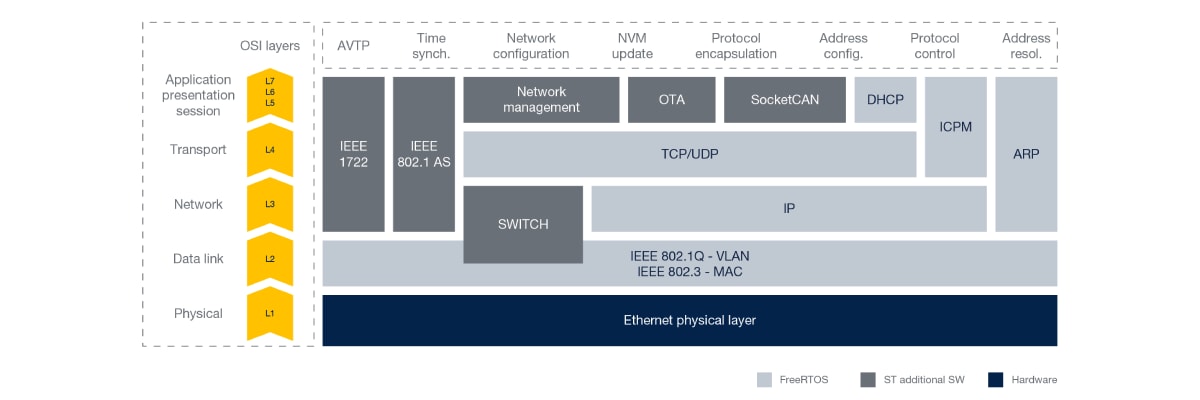
This underscores that the solution is not just a connectivity feature, but a complete system concept involving hardware, software, and timing coordination.
ST Stellar G6 can help support real-time processing, timing, and in-vehicle communication requirements in distributed automotive systems, including:
- AVTP audio transport
- Time synchronization
- Network configuration
- Embedded audio support
- Stack integration on the ZCU
Toward production-ready zonal audio
The presented reference design provides a strong foundation for collaboration with automotive ecosystem partners, including AutoCore for the Ethernet stack.
It shows how a zonal controller-based audio architecture can move from concept to system-level integration through joint hardware and software development.
This is especially relevant for teams exploring:
- Zonal ECUs with audio functions
- Ethernet-based distributed media systems
- Scalable in-cabin acoustic concepts
- Integration strategies for production platforms
Reference solution
A joint solution with AutoCore has already demonstrated end-to-end latency under two milliseconds, and ST is showcasing the technology live at Embedded World 2026 in Nuremberg:
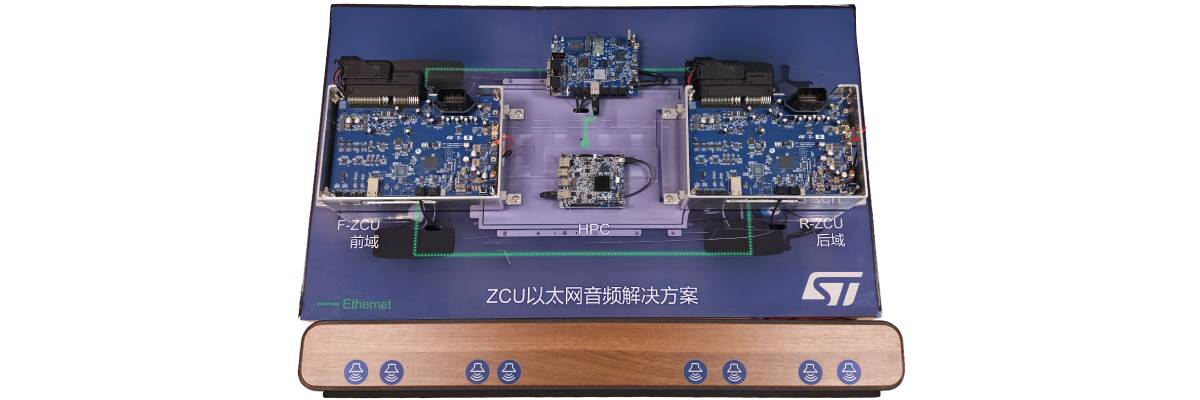
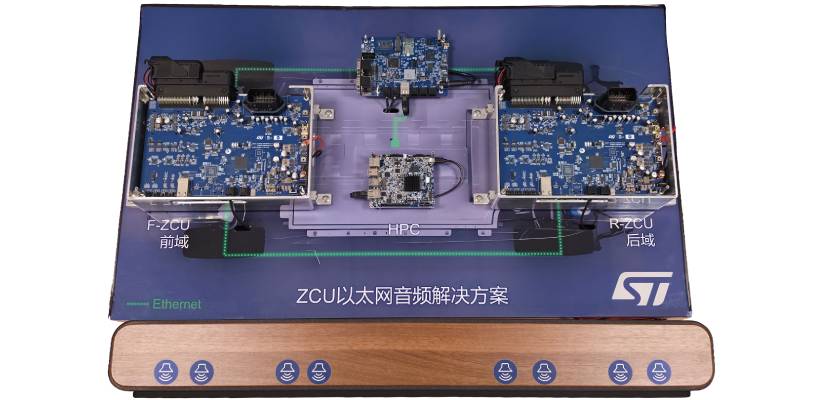
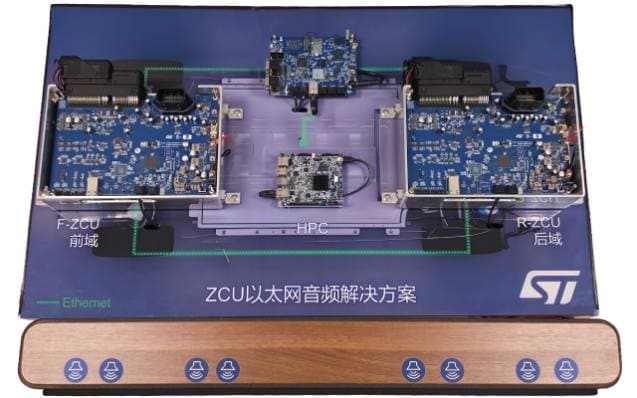
Demo showcased at Embedded World 2026
Audio over Ethernet solution hardware: demo ZCU solution boards and ZCU audio extension board for audio function enhancement:

ZCU 3.x solution board
ZCU 3.x solution board
System control & processing, with SR6G6C4, SR6G6C6 Stellar G6 32-bit Arm® MCU.
Power management, with SPSB100G power management IC and STPM801 HV hot swap, soft start and oring.
Power distribution protection, with eFuse:
- VNF1248F high-side switch controller with STi2Fuse,
- VNF9D1M5, VNF9D5F (2-channel) and VNF9Q20F (4-channel) HSD with STi2Fuse.
Switching, actuation, with:
- VN9D30Q100F / VN9D5D20FN HSD with 24-bit SPI interface,
- VN9004AJ / VND9008AJ HSD with current sense analog feedback,
- L99MH98 octal half-bridge pre-driver / VNH9030AQ integrated H-bridge motor driver,
- L9026 configurable multi-channel relay driver / L9800 8-channel LS driver,
- L99DZ200G front door device with LIN and HS-CAN.
Power switching, with low-voltage MOSFETs:
- STL325N4F8AG 40 V N-channel F8 STripFET MOSFET,
- STL210N4LF7AG, STL105N4LF7AG, STL76DN4LF7AG 40 V F7 STripFET MOSFET,
- STL135N8F7AG 80 V F7 STripFET MOSFET (soon available as F8).
Interface, with L9663 PSI5 transceiver IC.
Audio amplification, with HFDA801A 4x80W digital input class-D automotive audio amplifier.

ZCU 3.x audio extension board
ZCU 3.x audio extension board
Frequently asked questions
1 - What is Audio over Ethernet in automotive?
It is an architecture that carries audio data across an Ethernet backbone instead of relying on multiple dedicated audio connections.
2 - Why is this relevant to software-defined vehicles?
It is relevant because software-defined vehicles rely on flexible, networked, and software-managed architectures that can scale across vehicle platforms.
3 - What role does Stellar G6 play?
Stellar G6 helps support real-time processing, timing, and in-vehicle communication requirements in distributed automotive systems.