
Next-gen MEMS
The future of MEMS: emerging trends in smart devices & beyond
Micro-electromechanical systems (MEMS) have reshaped the landscape of modern electronics, evolving from niche components to the ubiquitous sensory backbone of our connected world. The initial waves of MEMS innovation brought motion sensing to smartphones and enhanced safety in vehicles. However, technology is now entering a new, more sophisticated era. The future of MEMS is not just about making sensors smaller or more accurate; it is about making them smarter, more autonomous, and capable of unlocking unprecedented applications across a vast spectrum of industries.Micro-electromechanical systems (MEMS) have reshaped the landscape of modern electronics, evolving from niche components to the ubiquitous sensory backbone of our connected world. The initial waves of MEMS innovation brought motion sensing to smartphones and enhanced safety in vehicles. However, technology is now entering a new, more sophisticated era. The future of MEMS is not just about making sensors smaller or more accurate; it is about making them smarter, more autonomous, and capable of unlocking unprecedented applications across a vast spectrum of industries.
For electronic engineers, staying ahead of these emerging trends is essential for driving next-generation product design. This article explores the key vectors of innovation shaping the future of MEMS technology, from the profound impact of on-chip artificial intelligence and the rise of advanced biosensors to the development of novel materials and energy harvesting capabilities that will power the devices of tomorrow.

Trend 1: on-sensor intelligence with edge AI and machine learning
The most significant trend shaping the future of MEMS is the shift from “sensing” to “understanding”. While intelligent sensors are already a reality, the next generation will drastically expand these capabilities. These upcoming MEMS devices will move beyond reporting raw data to processing and interpreting it at the extreme edge, directly on the chip. This evolution is made possible by the integration of increasingly power-efficient processing cores that allow for real-time decision-making.
Machine learning cores (MLC)
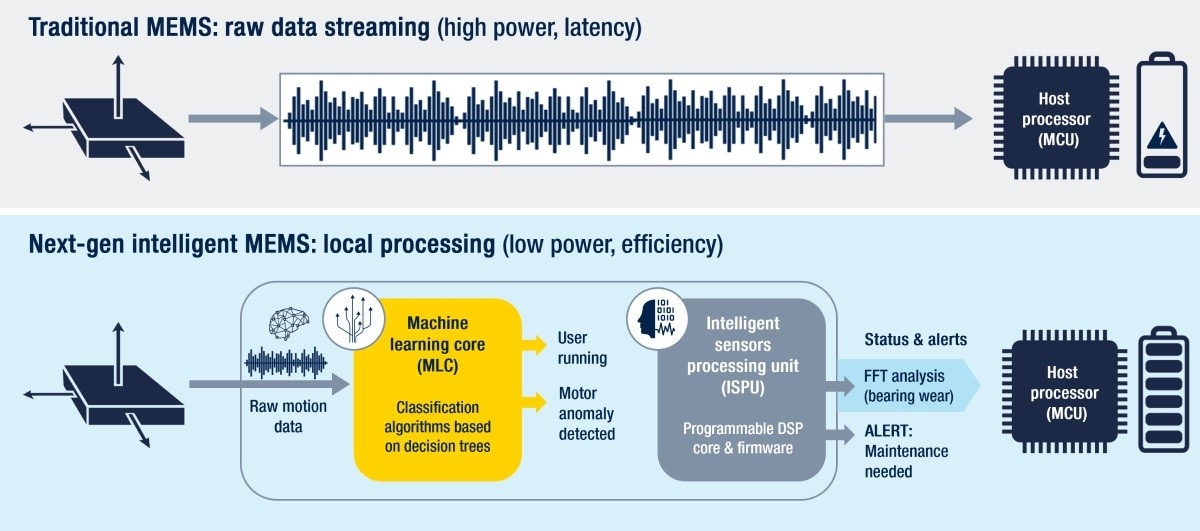
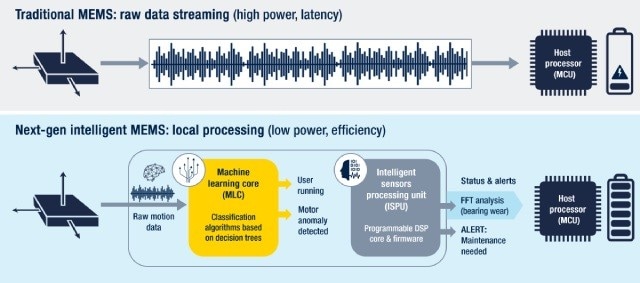
The integration of a machine learning core into a sensor's application-specific integrated circuit (ASIC) allows it to run classification algorithms based on decision trees.
- How it works: an accelerometer with an MLC can be trained to recognize a predefined set of complex motion patterns, such as the specific gait of its user or the vibration signature of a normally functioning industrial motor.
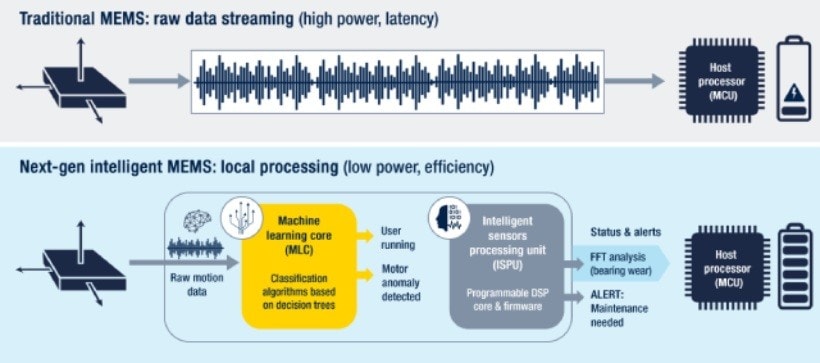
- System impact: instead of continuously streaming high-frequency data to a host processor, the sensor can output a context-aware status (e.g., “user is running”, “motor anomaly detected”). This approach significantly reduces system power consumption, which is a critical advantage for battery-powered IoT and wearable devices.instead of continuously streaming high-frequency data to a host processor, the sensor can output a context-aware status (e.g., “user is running”, “motor anomaly detected”). This approach significantly reduces system power consumption, which is a critical advantage for battery-powered IoT and wearable devices.
Intelligent sensor processing units (ISPU)
The ISPU takes this concept a step further by embedding a programmable, power-efficient digital signal processor (DSP) core and MEMS-specific firmware into the sensor.
- How it works: ISPU empowers engineers to run their own custom, high-complexity algorithms directly on the sensor. For example, an industrial vibration sensor with an ISPU could perform a fast Fourier transform (FFT) analysis, identify specific frequency peaks that indicate bearing wear, and wake up the main system to issue a maintenance alert.ISPU empowers engineers to run their own custom, high-complexity algorithms directly on the sensor. For example, an industrial vibration sensor with an ISPU could perform a fast Fourier transform (FFT) analysis, identify specific frequency peaks that indicate bearing wear, and wake up the main system to issue a maintenance alert.
- System impact: this enables highly sophisticated, application-specific data processing at the sensor node. It offloads the host MCU, reduces latency, and enhances data privacy by minimizing the transmission of raw data. This on-chip intelligence is a cornerstone of our advanced iNEMO inertial modules and is transforming application design.
Trend 2: advanced biosensors and chemical sensing
The next frontier for MEMS is the direct detection of biological and chemical markers, moving beyond physical phenomena like motion and pressure. This trend promises to revolutionize medical diagnostics and environmental monitoring.
Medical and wellness applications
MEMS biosensors are being developed to provide continuous, real-time monitoring of key biomarkers.
- Integrated biosensing: the goal is to integrate biological recognition elements, like enzymes or antibodies, with a MEMS transducer on a single chip. This would enable non-invasive, continuous monitoring of substances like glucose, lactate, or cortisol directly from sweat or interstitial fluid.
- Point-of-care diagnostics: MEMS-based microfluidic “lab-on-a-chip” systems will continue to shrink and become more sophisticated. In the future, a disposable cartridge could perform a complex blood analysis in minutes, detecting pathogens or cancer biomarkers at the patient's bedside instead of in a centralized lab.


Environmental and agricultural sensing
The same principles are being applied to create highly sensitive “electronic noses” for environmental and agricultural applications.
- Air quality monitoring: MEMS sensors will be able to detect specific volatile organic compounds (VOCs) and particulate matter with greater precision, enabling hyper-local, real-time air quality mapping in smart cities.
- Smart agriculture: chemical sensors could analyze soil composition in real-time or detect the specific gases released by ripening fruit, allowing for optimized irrigation, fertilization, and harvesting schedules.



Trend 3: innovation in materials and actuation
The performance and capabilities of future MEMS devices will be heavily influenced by the adoption of new materials beyond traditional silicon.
Piezoelectric MEMS (PZT)
Piezoelectric materials, which deform when a voltage is applied, are enabling a high-performance class of MEMS actuators. This innovation is fueled by Lab-in-Fab collaborations, where research and industrial-scale manufacturing converge to accelerate the transition of novel PZT materials from the cleanroom to the consumer market.
- MEMS speakers: piezoelectric MEMS speakers are revolutionizing audio in small devices like TWS earbuds and smart glasses. Their solid-state design allows for an incredibly thin form factor, high power efficiency, and excellent clarity in mid and high frequencies.
- Micro-pumps and autofocus: the same technology can be used to create tiny pumps for drug delivery systems or actuators for rapid lens movement in smartphone camera autofocus and optical image stabilization systems.
2D materials like graphene
Graphene and other two-dimensional materials offer extraordinary mechanical strength and electrical conductivity in a single atomic layer.
A nano-electromechanical system (NEMS) resonator with a graphene membrane would have an incredibly low mass and high resonant frequency, making it theoretically capable of detecting the mass of a single molecule that lands on its surface. This capability could lead to a new generation of mass spectrometers and chemical detectors.
Trend 4: sensor fusion and contextual awareness
The future is not about single sensors but about sensor ecosystems. Advanced algorithms will fuse data from a suite of MEMS and sensors to build a rich, contextual understanding of the environment and the user’s situation.
- Smarter user interfaces: while sensor fusion is already a standard feature, future systems will integrate an even broader array of inputs, fusing data from accelerometers, gyroscopes, magnetometers, and pressure sensors with environmental and biometric data. This evolution allows devices to move beyond simple motion tracking to true contextual awareness; for instance, your device won't just detect movement, but will understand that you are walking up a specific flight of stairs inside a precise building.
- Enhanced automotive safety: in vehicles, fusing data from inertial sensors, radar, and vision systems is already the foundation of advanced driver-assistance systems (ADAS). Future automotive sensors will provide even more redundancy and precision, enabling higher levels of autonomous driving. This fusion provides a more robust and reliable picture than any single sensor could deliver alone.


Trend 5: energy harvesting and zero-power sensing
To power the trillions of sensors envisioned for the IoT, reliance on batteries must be reduced. MEMS-based energy harvesters are a key enabling technology for creating truly autonomous, "fit-and-forget" sensor nodes.
- Vibration harvesting: piezoelectric or electrostatic MEMS harvesters can convert ambient mechanical vibrations from machinery, infrastructure, or even human movement into usable electrical energy.
- Thermal and RF harvesting: other MEMS designs aim to generate power from temperature gradients (thermoelectric effect) or by capturing ambient radio frequency (RF) energy. While the power generated is small, it is often sufficient to run an ultra-low-power sensor and radio, especially when combined with the power savings from on-chip intelligence.
Engineering an intelligent and perceptive future
The future of MEMS is one of escalating intelligence, diversification, and autonomy. These emerging trends are pushing sensor technology far beyond simple measurement, creating devices that can perceive, understand, and even act upon their environment with minimal power and human intervention.
For electronic engineers, these advancements present both a challenge and an opportunity. STMicroelectronics stands at the forefront of this evolution, providing the end-to-end ecosystem (from intelligent sensors and novel materials to advanced fusion algorithms) needed to bring these designs to life.
The next generation of smart devices will be more efficient, intuitive, and deeply integrated into our lives. The journey of MEMS is far from over; it is accelerating into a future limited only by our imagination.