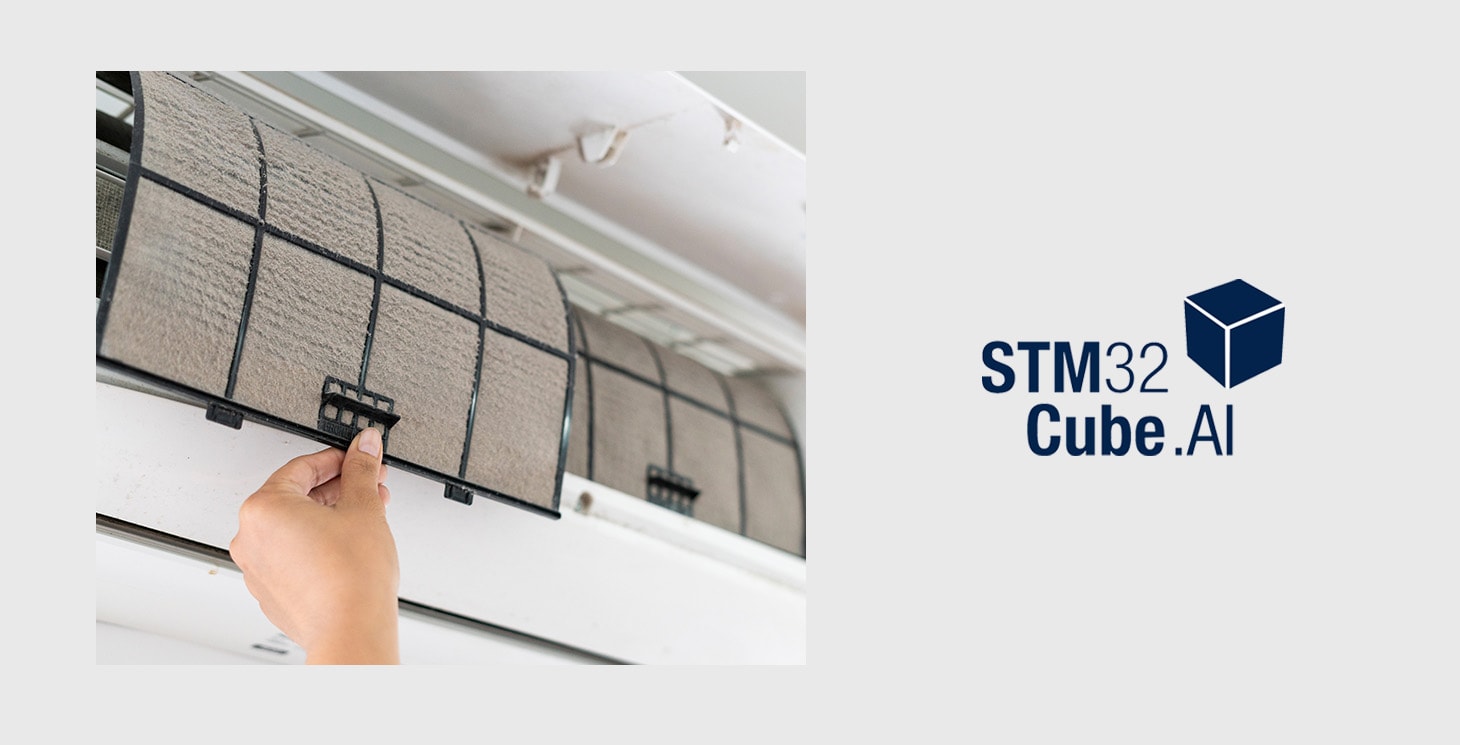
Fan anomaly classification based on ultrasound analysis
Neural Network classification based on a high-frequency analog microphone pipeline.
Approach
The ultrasound-based classification model takes almost one second of data, then preprocesses it using the mel-frequency cepstral coefficients (MFCC), and then feeds it to a pre-trained neural network. The network is trained for four classes [ 'Off', 'Normal', 'Clogging', 'Friction' ].The ultrasound-based classification captures audio at a 192 kHz (16-bit, 1 channel) rate using the on-board analog MEMS microphone. Every millisecond, a DMA interrupt is received with the last 192 audio samples. These samples are then accumulated in a sliding window consisting of 4096 samples with no overlap. The buffer is injected every 21,33 ms into USC preprocessing for feature extraction. The USC preprocessing extracts ultra sound features: MFCC (46x32) spectrogram.
For computational efficiency and memory management optimization, the step is divided into two routines:
- The first part computes one of the 46 MFCC columns from the time domain input signal into the Mel scale using FFT and Filter bank applications (32 mel bands).
- The second part, when all 32 columns have been calculated (i.e., after 981 ms), a log scaling is applied to the mel scaled spectrogram, creating the input feature for the USC convolutional neural network.
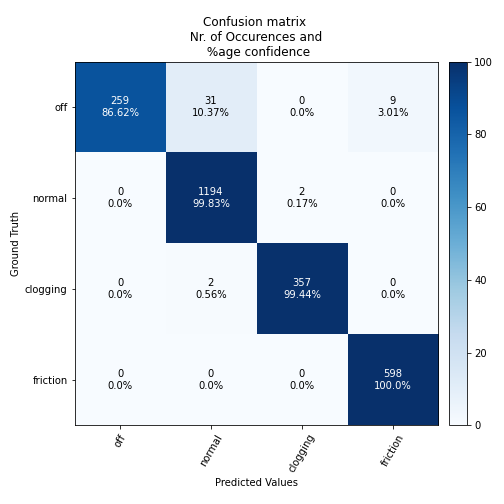
Every 981 ms, the (46x32) MFCC spectrogram is fed to the USC convolutional neural network input. The Model classifies anomalies among four classes: [ 'Off', 'Normal', 'Clogging', 'Friction']. This model is created to work for a USB fan when the fan is running at the maximum speed and does not work very well when tested on other speeds
Sensor
Data
Results
Model ST Convolutional Neural Network Quantized
Input size: 46x32
Complexity: 565 K MACC
Memory footprint:
163 KB Flash for weights
74 KBRAM for activations
Performance on STM32L4R9 (Low Power) @ 120 MHz
Pre-processing: 24 MHz; 46 MFCC column computation per second, 4,2 ms per column
NN processing: 1 inference per second; 10 MHz, 78 ms per inference
Confusion matrix

Resources
A free STM32Cube expansion package, X-CUBE-AI allows developers to convert pretrained AI algorithms automatically, such as neural network and machine learning models, into optimized C code for STM32.
Compatible with STM32L4 series
The STM32 family of 32-bit microcontrollers based on the Arm Cortex®-M processor is designed to offer new degrees of freedom to MCU users. It offers products combining very high performance, real-time capabilities, digital signal processing, low-power / low-voltage operation, and connectivity, while maintaining full integration and ease of development.