Secure entry systems using id3 face recognition with liveness detection

Industries such as transportation, smart buildings, and smart homes face a growing need for secure, real-time access control to prevent identity fraud and ensure reliable entry. However, traditional client-server facial recognition systems often introduce high latency and depend on continuous network connectivity. To overcome these challenges, id3 Technologies turned to edge AI to deliver a faster, more resilient solution.
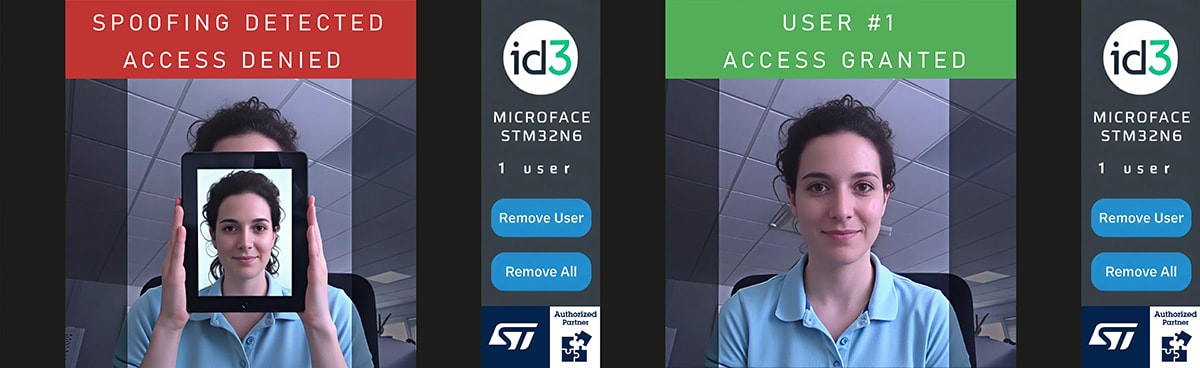
Leveraging the powerful STM32N6 microcontroller, featuring the Neural-ART accelerator, id3’s integrated solution delivers ultra-fast, local facial recognition without cloud dependency. With embedded Time-of-Flight (ToF) sensor liveness detection, the system resists spoofing attempts, providing instant, energy-efficient verification even in varied lighting conditions.
Approach
The limitations of legacy solutions inspired a new approach using lightweight facial recognition models running directly on STM32 microcontrollers. This innovation enables real-time, privacy-first biometric authentication without relying on cloud services or external accelerators. Optionally this may come with a mobile app companion which modernizes user onboarding, providing intuitive face registration and secure transmission of biometric features to the embedded device.
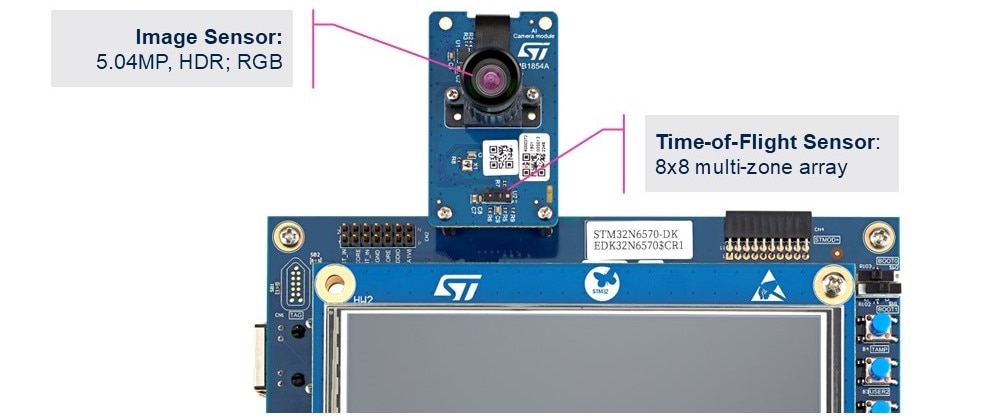
id3’s access control solution acquires data simultaneously from a high-dynamic-range (HDR) RGB sensor and an 8x8 multi-zone Time-of-Flight (ToF) sensor. Sensor fusion is processed locally by STM32N6 running the MicroFace SDK, which rapidly detects, verifies liveness, and extracts biometric features for matching against local identity databases, all on-device.
This approach using edge AI and ToF detection offers several key advantages:
Low latency: the MicroFace SDK detects faces in 8 ms and extracts features in 20 ms.
Local processing: runs without servers, lowering costs and boosting data security.
Security: liveness detection stops fake attempts in 60 ms. ToF offers stronger protection than 2D methods, even in poor lighting, preventing identity theft.
Low consumption: runs continuously with low energy use, prolonging device life through optimized AI models.
Application overview
The MicroFace SDK uses combined RGB and ToF data with advanced neural processing to deliver fast, secure, and accurate on-device facial recognition and liveness detection.
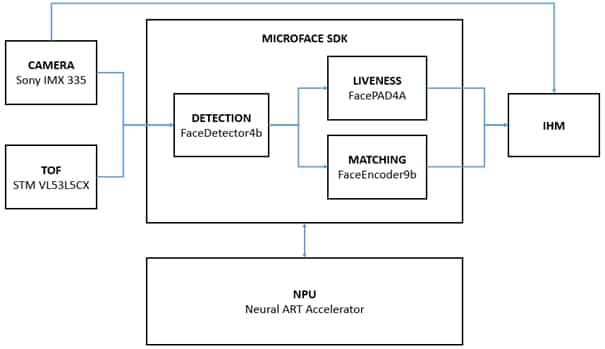
1 - The process begins with simultaneous acquisition of multi-modal data. An RGB sensor captures high-quality images across varied lighting conditions, while a ToF sensor delivers an 8×8 depth map for precise 3D spatial representation. Both data streams are fed into the STM32N6 embedded platform.
2 - The Microface SDK then applies deep learning-based facial detection to localize faces in the RGB image. In parallel, its liveness detection module analyzes the ToF depth map for inconsistencies, reflectivity, and micro-movements to distinguish live users from spoofing attempts (photos, videos, masks), improving robustness under challenging lighting.
3 - Once liveness is verified, the SDK extracts biometric features using quantized CNNs. These networks generate compact, discriminative facial embeddings, which are matched against an on-device database of enrolled templates.
4 - To meet real-time requirements within embedded constraints, neural computations are offloaded to the STM32N6’s neural processing unit (NPU). Optimized for parallel matrix operations, the NPU accelerates detection, embedding, and liveness analysis with low latency and high energy efficiency.
5 - Finally, the Microface SDK outputs the recognition result (valid match, unverified identity, or detected fraud) via the human-machine interface (HMI), ensuring secure and responsive facial recognition on-device.
Sensor
- RGB image sensor: Sony IMX335, 5.04 M pixels, high dynamic range (HDR)
- Time-of-Flight (ToF) sensor: ST VL53L5CX, 8x8 multi-zone telemetry sensor. This sensor significantly improves liveness detection and performance in difficult lighting conditions.
Dataset and model
Dataset:
- The facial recognition algorithm from id3 Technologies is the result of more than 25 years of continuous innovation. It has been trained and validated on a diverse set of millions of images, ensuring robust performance across a wide range of skin tones, ethnicities, and facial features. To verify this, the algorithm (id3_008) was submitted to and evaluated by the National Institute of Standards and Technology (NIST) Face Recognition Technology Evaluation (FRTE).
Model:
- MicroFace SDK: FaceDetector4B, FaceEncoder9B and FacePAD4A (id3)
- Trainable parameters: 5 201 000
- MACC: 6,02E+8
- Max enrolled faces: 1000 (but is adjustable)
Results
Face detection: 8 ms
Liveness detection (PAD): 60 ms
Facial feature extraction: 20 ms
Face matching (1,000 users): 4.5 ms
SRAM: <0.8 MB (MicroFace Library) | Demo: 0.34 MB (Demo)
FLASH: 8 MB (Demo + Library)
Author: Lucas L'HUILLIER (id3 Technologies) | Last update: Sept, 2025

Optimized with STM32Cube.AI
A free STM32Cube expansion package, X-CUBE-AI allows developers to convert pretrained AI algorithms automatically, such as neural network and machine learning models, into optimized C code for STM32.
Most suitable for STM32N6 Series
The STM32 family of 32-bit microcontrollers based on the Arm Cortex®-M processor is designed to offer new degrees of freedom to MCU users. It offers products combining very high performance, real-time capabilities, digital signal processing, low-power / low-voltage operation, and connectivity, while maintaining full integration and ease of development.