
NB-IoT essentials: technology, applications and design
NB-IoT essentials: technology, applications and design
Narrowband-IoT (NB-IoT) is a low-power wide-area network technology designed for secure, long-range, battery-friendly connectivity at scale. It is the connectivity layer behind smart meters in basements, asset trackers in transit, and sensors monitoring infrastructure across entire cities.
This guide brings together the essentials of NB-IoT: what it is, how it works, where it fits, how it compares to other LPWAN options and links you to deeper, application-specific resources built around the ultracompact ST87M01 NB-IoT module, with optional GNSS and Wi-Fi positioning.
Who this guide is for
NB-IoT design decisions involve different teams depending on the application. Use the path below that best fits your project:
- If you are designing smart cities, smart metering or utilities: go to the Smart cities and smart metering with NB-IoT guide.
- If you are working on asset tracking, smart labels or logistics: see Asset tracking and smart labels with NB-IoT.
- If you are building condition monitoring or industrial IoT solutions: open Industrial IoT and condition monitoring with NB-IoT.
- If you are still evaluating between LPWAN technologies: read NB-IoT vs LPWAN: choosing the right technology.
1. What is NB-IoT?
NB-IoT (Narrowband Internet of Things) is a 3GPP cellular standard purpose-built for low-power, low-data-rate IoT devices. It operates in licensed spectrum and reuses existing 4G and 5G infrastructure, which means it benefits from cellular-grade reliability and security without the cost and complexity of a dedicated network.
The combination delivers four properties that matter for IoT deployments:
- Wide-area coverage, including deep indoor locations with up to 20 dB improved link budget versus conventional LTE, and native support for IPv6
- Multi-year battery life: extended power-saving modes (PSM and eDRX) keep typical sensors alive for ten years or more on a small battery.
- Massive device density: tens of thousands of devices per cell, designed for citywide and nationwide deployments.
- Cellular-grade security: 256-bit encryption, mutual authentication, and the operator-managed security model that already protects billions of mobile connections.
2. How NB-IoT works
Technology basics
NB-IoT is built on LTE foundations and optimized for small, infrequent, delay-tolerant data exchanges:
- It uses Orthogonal Frequency Division Multiplexing (OFDM) downlink, with QPSK and BPSK modulation, making it robust against noise and interference.
- It operates in narrowband LTE channels, supporting both single-tone and multi-tone uplink, enabling a flexible trade-off between coverage depth and throughput.
- Its embedded stack supports IPv4/IPv6, which is critical for managing the address space of large-scale device fleets.
Security and infrastructure
NB-IoT inherits the same security mechanisms used in mobile networks today: 256-bit encryption standardized by 3GPP, SIM-based mutual authentication, and the GSMA's global infrastructure for roaming and device management. For deployments subject to regulation this is as important as raw connectivity:
- Confidentiality and integrity of data over the air.
- Operator-grade availability and quality of service for regulated utilities and public services.
- Standardized, multi-vendor interoperability between devices, networks and operators worldwide.
Insights: NB-IoT in 2026: market context
ABI Research forecasts strong growth in NB-IoT shipments across EMEA between 2025 and 2029. The growth is driven by three converging trends: regulated smart-meter rollouts under European energy directives, the EU Radio Equipment Directive Delegated Act (RED-DA) cybersecurity requirement that came into force in 2025, and a measurable shift toward Western-controlled supply chains for critical infrastructure components. Together, these are reshaping which NB-IoT modules buyers can specify into long-lived, regulated deployments.
3. NB-IoT vs other LPWAN technologies
LPWAN is a family of technologies: NB-IoT, LTE-M, LoRaWAN and Sigfox each occupy a different point on the trade-off curve between coverage, power, data rate and ecosystem maturity. Choosing well at the start of a project saves substantial rework later.
| NB-IoT | LoRaWAN | Sigfox |
|---|---|---|---|
| Spectrum | Licensed cellular | Unlicensed sub-GHz ISM | Unlicensed sub-GHz ISM |
| Typical payload | Up to ~1.6 kB per message | Up to ~243 B (region-dependent) | 12 B uplink, 8 B downlink |
| Downlink | Robust, bidirectional | Limited, asymmetric | Very limited |
| Coverage model | Public cellular networks | Public or private gateways | Operator-only |
| Battery life | Multi-year with PSM/eDRX | Multi-year, application-dependent | Multi-year, very small payloads |
| Security | Cellular-grade, SIM-authenticated | AES-128, key-management dependent | Lightweight, vendor-managed |
| Standardization | 3GPP global | LoRa Alliance | Proprietary |
For a deeper, side-by-side analysis including LTE-M and decision criteria for each application class, see NB-IoT vs LPWAN: choosing the right technology.
4. Where NB-IoT fits: applications
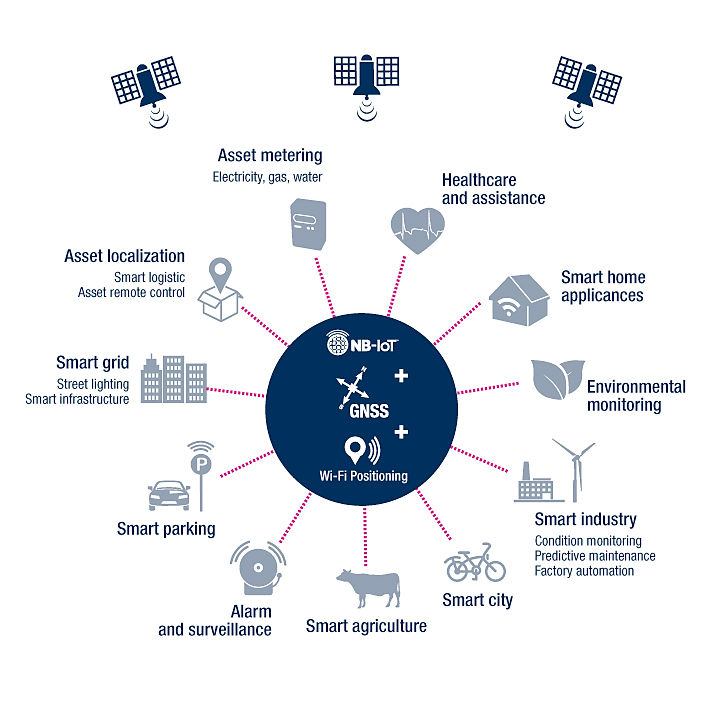
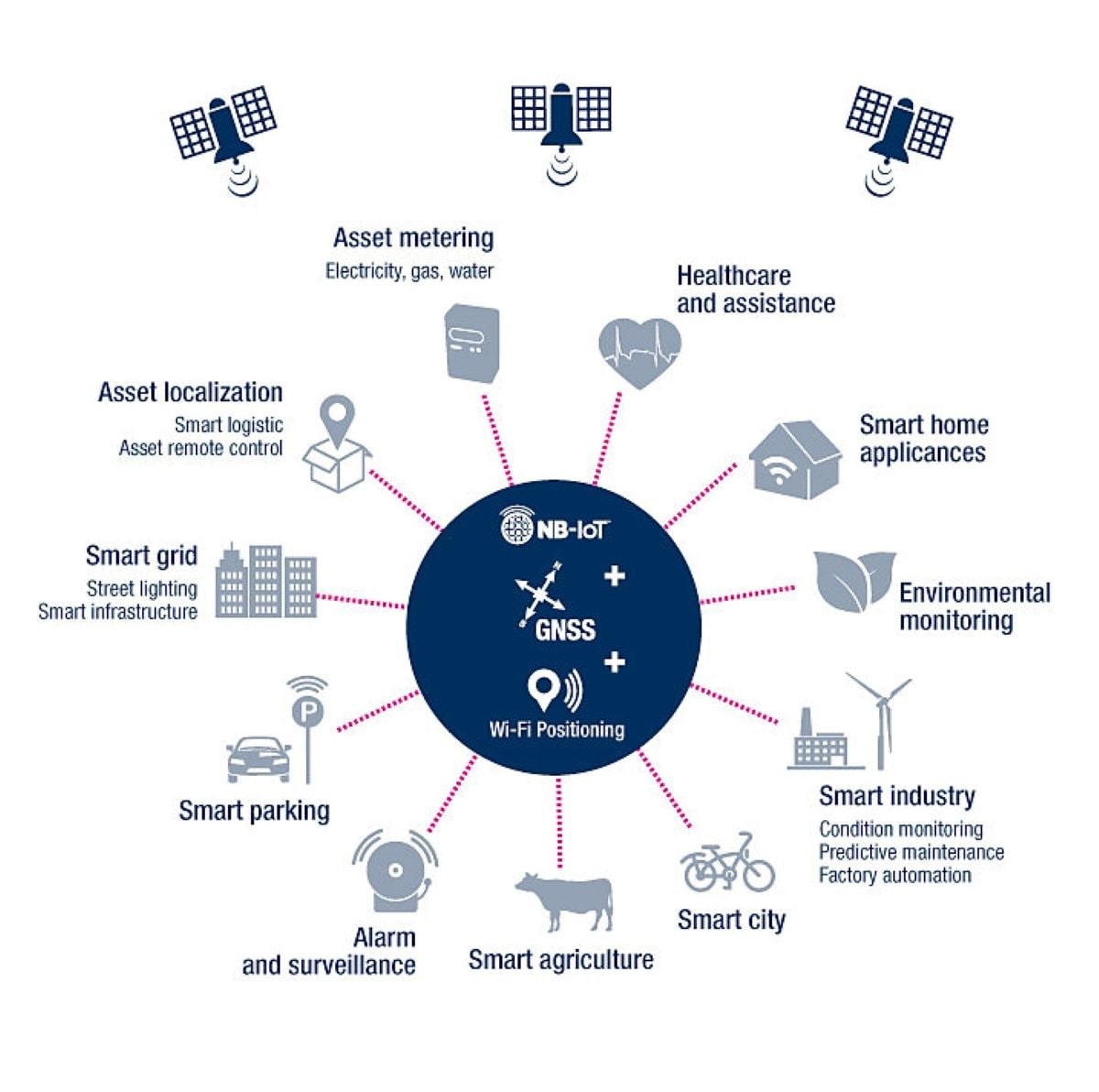
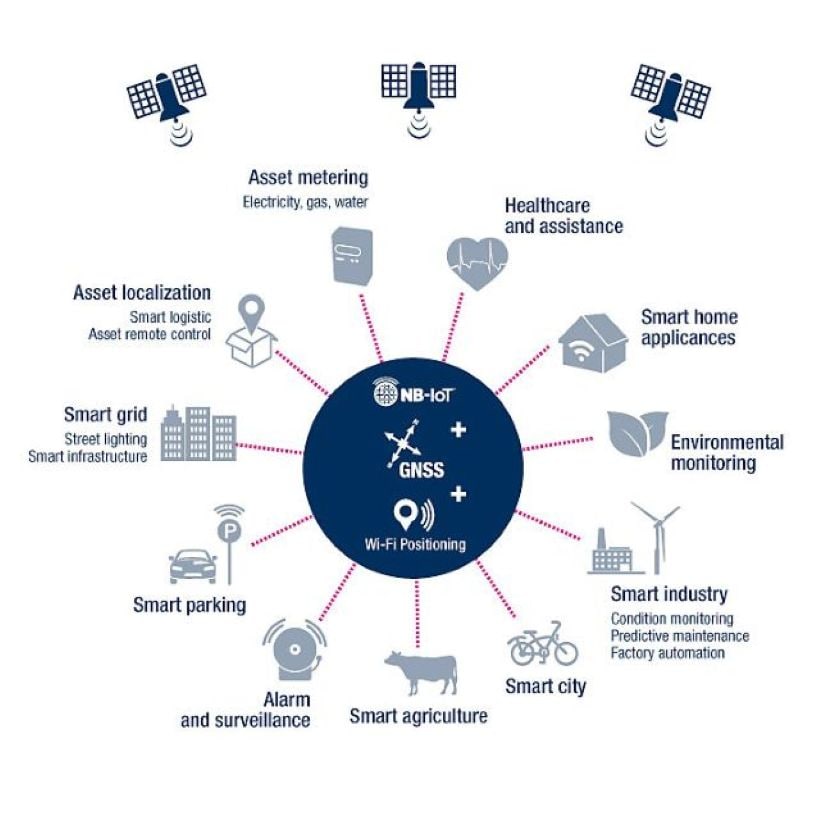
NB-IoT is the right choice when you need wide coverage, long battery life and small, infrequent data transmissions. Four application clusters dominate today:
- Smart metering: electricity, gas and water meters reporting consumption from basements and meter rooms, where deep indoor coverage and a multi-year battery life are non-negotiable.
- Smart cities: smart street lighting, parking sensors, waste-collection bins, environmental monitoring and infrastructure-health sensors.
- Asset tracking and smart labels: location-aware tags for goods, pallets, livestock and movable equipment, often with GNSS or Wi-Fi positioning for outdoor and indoor location.
- Industrial IoT: condition monitoring, tool tracking, and safety devices across large industrial campuses where wired connectivity is impractical.
5. Designing with ST NB-IoT solution
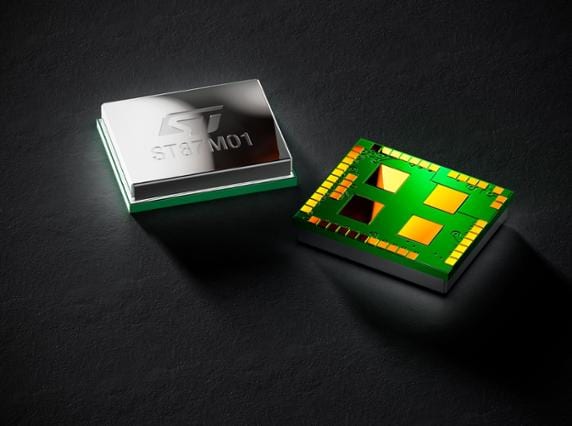
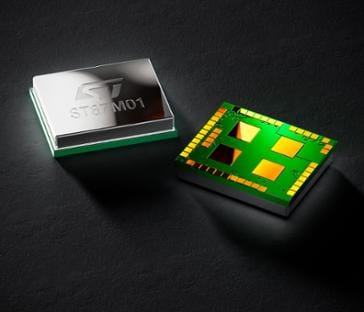
The ST87M01 is an ultracompact, industrial-grade NB-IoT module designed for the long lifecycles required by smart-city, metering, asset-tracking and industrial deployments. It is at the core of the ST NB-IoT ecosystem: module, evaluation hardware, software stack, and partner-validated reference designs.
ST87M01 at a glance
- LTE Cat NB2 (3GPP Release 15)
- B1/B3/B5/B8/B20/B28 certified bands for EMEA
- B2/B4/B5/B12/B13/B66/B85 certified bands for N. AME
- B3/B5/B8/B28 certified bands for Brazil
- Ultracompact 10.6 x 12.8 mm LGA package, the smallest NB-IoT module on the market.
- Optional integrated GNSS and Wi-Fi positioning in the ST87M01-1301 and ST87M01-2301 variants for asset tracking and outdoor/indoor geolocation.
- Power-saving mode floor current below 1.2 µA, off-mode current below 0.5 µA: designed for multi-year battery operation.
- Embedded protocol stack: IPv4/IPv6, TCP/UDP, CoAP, LwM2M, MQTT, HTTP/HTTPS, DTLS, reducing the need for an external MCU in lightweight designs.
Choosing a protocol
The module supports a complete protocol full stack, so the real question is which protocol to use. For transport, UDP is the lightest option with the lowest overhead, and ST recommends it for applications that can tolerate occasional data losses. For messaging, CoAP and LwM2M suit very small payloads on resource-constrained devices, while MQTT suits long-standing connections and larger payloads.
- 100% ST-controlled SoC, RF front-end and module design, manufactured in Europe, with a 15-year longevity commitment.
- RED, RED-DA and GCF certified; certified by Vodafone, TIM, Deutsche Telekom, Bouygues, Telefonica and SFR.
6. Evaluation hardware and software ecosystem
Two complementary evaluation platforms cover the ST87M01's range of applications:

STEVAL-NBIOTV1
STEVAL-NBIOTV1
NB-IoT evaluation platform and reference design for asset tracking and smart cities with ST87M01 module, an STM32U5 microcontroller and a sensor suite (pressure, accelerometer, temperature, humidity).

EVKITST87M01-2
EVKITST87M01-2
An Arduino-compatible shield based on the ST87M01-1301 variant, with NB-IoT, GNSS and Wi-Fi positioning antennas, a SIM slot and USB connectivity for AT-command control. Available with a Wireless Logic Conexa Low Power SIM (50 MB included for six months).
The software ecosystem includes the ST87 Easy Connect library for C-based MCU integration, the ST87MGUI configuration tool, and the ECLIB application example demonstrating the Easy Connect Library (ECLIB) on STM32 platforms, built for the ST87M01 module and boards such as the NUCLEO-U545RE-Q + EVKITST87M01-2 and STEVAL-NBIOTV1. All are available from the product folder on st.com.
Take the next step
Learn more about NB-IoT for your application
- Smart cities whitepaper: system architectures, power budgeting, total ownership cost for citywide deployments.
- Smart cities and asset tracking with NB-IoT: use cases, ST87M01 features for utilities, STEVAL-NBIOTV1 reference design.
- Asset tracking and smart labels with NB-IoT: the all-in-one NB-IoT, GNSS and Wi-Fi positioning approach.
- Industrial IoT and condition monitoring with NB-IoT: industrial-grade design, integration ecosystem and supply-chain stability.
Evaluate the ST87M01
- Webinar: Wireless performance that holds beyond the reference design, with Ignion, on antenna design and Virtual Antenna technology.
- Webinar: From first data to fleet operations with lifecycle visibility, with Wireless Logic, on connectivity management at scale.
- ST87M01 product page: datasheet, technical documentation, ordering.
Start designing
- EVKITST87M01-2 evaluation kit: Arduino-compatible shield with Conexa Low Power SIM.
- STEVAL-NBIOTV1 reference design: smart-city and asset tracking node reference.
- STSW-NBIOTV1: Application examples for STEVAL-NBIOTV1 with ST87M01 NB-IoT and GNSS module.
- STSW-ST87M01: ST87M01 firmware.
- STSW-ST87MGUI: Windows GUI for easy ST87Mxx module configuration and control, with integrated documentation and user guides.
- STSW-ST87ECLIB: Software for ST87Mxx evaluation tool.
- STSW-ST87M01APP: ST87M01 easy connect library application examples for STM32.