Acoustic scene classification
Identify different environments (indoor, outdoor, in-car) using a simple microphone.

Approach
The goal of Acoustic Scene Classification (ASC) is to classify the actual environment into one of the provided three predefined classes (indoor, outdoor, in-vehicle) characterized with the acoustic captured by a single digital microphone.The demo runs on a small form factor board Sensor Tile that comes along with a smartphone application connected through Bluetooth Low Energy.
We used the FP-AI-SENSING1 function pack to build this example, running on an STEVAL-STLKT01V1 board. The ASC configuration captures audio at a 16 kHz (16-bit, 1 channel) rate using the on-board MEMS microphone.Every millisecond, a DMA interrupt is received with the last 16 PCM audio samples. These samples are then accumulated in a sliding window consisting of 1024 samples with a 50% overlap. For every 512 samples (i.e.,32 ms), the buffer is injected into the ASC preprocessing for feature extraction.The ASC preprocessing extracts audio features into a LogMel (30x32) spectrogram.
For computational efficiency and memory management optimization, the step is divided into two routines:
- The first part computes one of the 32 spectrogram columns from the time domain input signal into the Mel scale using FFT and Filter bank applications (30 mel bands).
- The second part, when all 32 columns have been calculated (i.e., after 1024 ms), a log scaling is applied to the mel scaled spectrogram, creating the input feature for the ASC convolutional neural network.
Every 1024ms, the (30x32) LogMel spectrogram is fed to the ASC convolutional neural network input, which can then classify the output labels: indoor, outdoor and in-vehicle.
Sensor
Data
Results
Model ST Convolutional Neural Network Quantized
Input size: 30x32
Complexity 517 K MACC
Memory footprint:
31 KB Flash for weights
18 KBRAM for activations
Performance on STM32L476 (Low Power) @ 80 MHz
Use case: 1 classification/sec
Pre/Post-processing: 3.7 MHz
NN processing: 6 MHz
Power consumption (1.8 V)
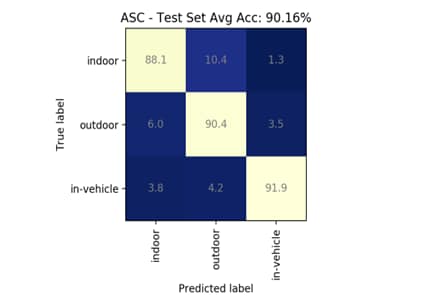
Confusion matrix

Resources
A free STM32Cube expansion package, X-CUBE-AI allows developers to convert pretrained AI algorithms automatically, such as neural network and machine learning models, into optimized C code for STM32.
The STM32 family of 32-bit microcontrollers based on the Arm Cortex®-M processor is designed to offer new degrees of freedom to MCU users. It offers products combining very high performance, real-time capabilities, digital signal processing, low-power / low-voltage operation, and connectivity, while maintaining full integration and ease of development.