Electrical fault detection and classification
Detect and classify electrical anomalies in a power system.

In the realm of electrical systems, identifying and resolving faults swiftly is paramount to ensure safety, prevent equipment damage and maintain uninterrupted operations. From power distribution networks to complex industrial systems, accurately detecting and classifying electrical faults is critical for the smooth operation of these infrastructure. However reactive maintenance based on human expertise has its limits: lack of real-time monitoring, prone to human error, limited scalability, etc.
New technologies such as Artificial Intelligence (AI) are transforming the way we maintain electrical systems, enabling proactive and precise identification of potential faults to minimize the impact of disruptions.
New technologies such as Artificial Intelligence (AI) are transforming the way we maintain electrical systems, enabling proactive and precise identification of potential faults to minimize the impact of disruptions.
Approach
This use case is based on the "Electrical Fault detection and classification" dataset from Kaggle.
The goal was to first detect an anomaly in the power system, and then classify the detected anomaly in one of the 6 classes of possible anomalies.
With a reference power system consisting of four generators with three phases (A, B and C), the data consists of 12,000 data points for the line voltages and currents for each of the three phases.
We then used NanoEdge AI Studio to create an N-Class classification model based on these inputs to detect and classify electrical anomalies.
The goal was to first detect an anomaly in the power system, and then classify the detected anomaly in one of the 6 classes of possible anomalies.
With a reference power system consisting of four generators with three phases (A, B and C), the data consists of 12,000 data points for the line voltages and currents for each of the three phases.
We then used NanoEdge AI Studio to create an N-Class classification model based on these inputs to detect and classify electrical anomalies.
Sensor
Current sensors and voltage sensors.
Data
2 classes for anomaly detection
6 classes for N-class classification
Signal length 6 (multi-sensors)
Data rate 1000 Hz
- Regular
- Abnormal
6 classes for N-class classification
- No fault
- Line-to-ground (LG) fault (between Phase A and Ground)
- Line-to-line (LL) fault (between Phase A and Phase B)
- Line-to-line-to-ground (LLG) fault (between Phases A, B and Ground)
- Line-to-line-to-line (LLL) fault (between all three phases)
- Line-to-line-to-line-to-ground (LLLG) fault (three-phase symmetrical fault)
Signal length 6 (multi-sensors)
Data rate 1000 Hz
Results
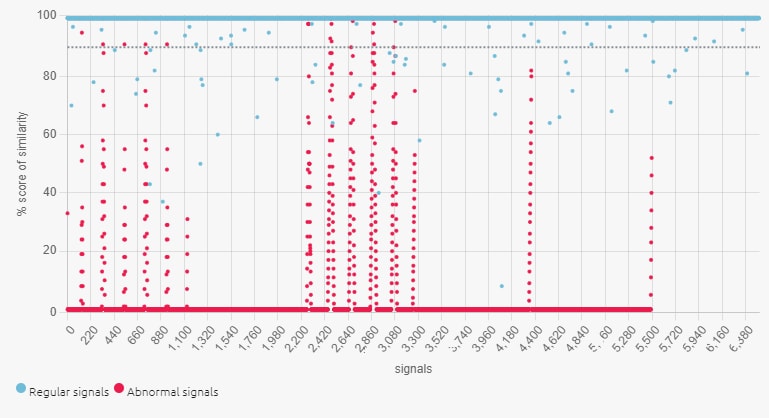
Anomaly detection:
98.90% accuracy, 0.6 Kbytes of RAM, 7.1 Kbytes of Flash memory
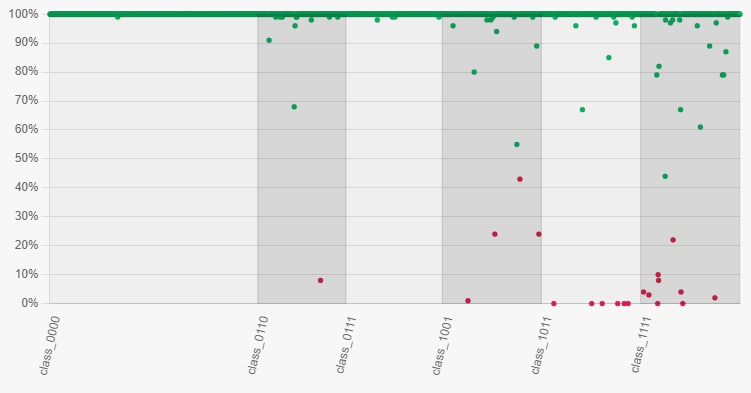
Fault classification:
98.51% accuracy, 0.1 KB RAM, 214.9KB Flash


Resources
Model created with NanoEdge AI Studio
A free AutoML software for adding AI to embedded projects, guiding users step by step to easily find the optimal AI model for their requirements.
The STM32 family of 32-bit microcontrollers based on the Arm Cortex®-M processor is designed to offer new degrees of freedom to MCU users. It offers products combining very high performance, real-time capabilities, digital signal processing, low-power / low-voltage operation, and connectivity, while maintaining full integration and ease of development.