
The Ultimate Guide to Current Sensing
Current sensing is a critical function in modern electronic systems, enabling real-time monitoring and control of electrical currents in various applications such as motor control, battery management, and power distribution.
This guide provides an overview of different current sensing methods, their operating principles, and the key parameters to consider when selecting a current sensing amplifier.
What is current sensing?
Current sensing is a fundamental technique used to measure electrical current flowing through a conductor or circuit. It plays a vital role in applications ranging from battery management and motor control to power distribution and overcurrent protection.
Accurate current measurement enables improved system monitoring, safety, and efficiency.STMicroelectronics provides a broad portfolio of current sense amplifier ICs designed to meet the needs of diverse applications, offering high precision, extended voltage ranges, and robust performance.
How does current sensing work?
Shunt current sensing is based on Ohm’s law, where the voltage drop (VSENSE) across a precision resistor (Shunt resistor) is proportional to the current flowing through it:
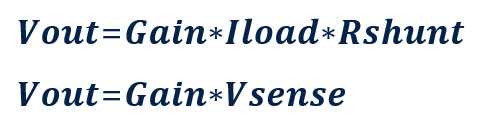
VSENSE is generally small, to limit power dissipation losses.
.png)
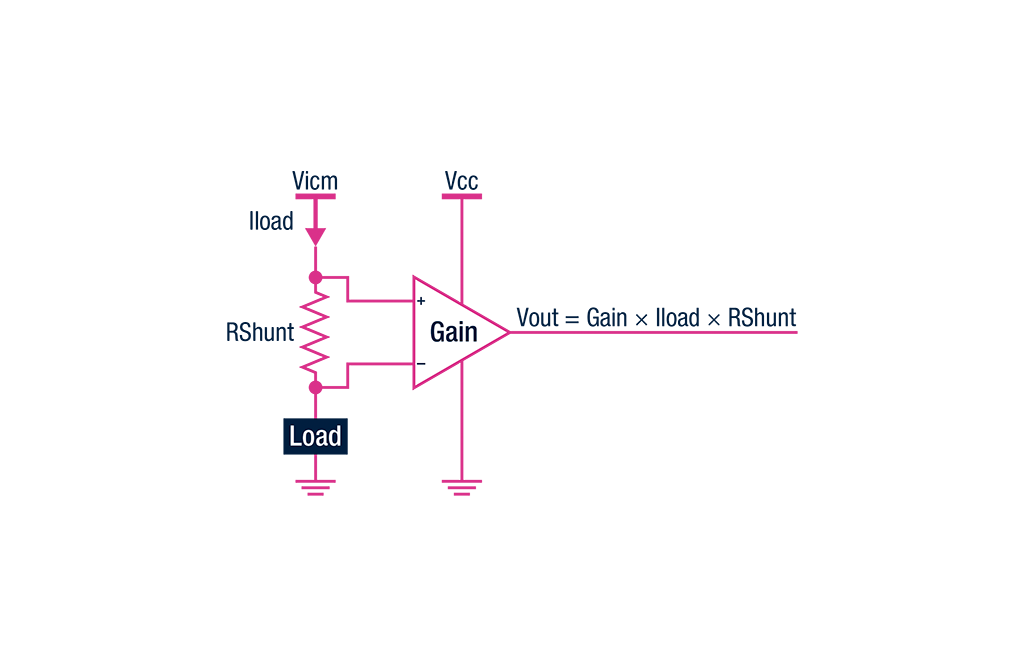
VSENSE is then amplified with an internal instrumentation amplifier. The resulting output voltage (VOUT) is a voltage which is proportional to the Ioad current. It can then be processed with an ADC (analog-to-digital converter).
Why current sensing matters

Real-time monitoring
Enables dynamic control and diagnostics

Safety
Detects overcurrent conditions to protect circuits

Energy efficiency
Optimizes power consumption by monitoring load currents

System reliability
Prevents damage and extends equipment life
Benefits of accurate current sensing
- Enhanced safety and protection
- Improved efficiency and performance
- Predictive maintenance and fault detection
- Data-driven optimization for smart systems
Key parameters of current sensing
When selecting a current sensing amplifier, the following parameters are critical:
- Input Common Mode Voltage (Vicm): The voltage range at the input pins is relative to ground. Extended Vicm allows sensing in high-voltage environments such as automotive 48 V systems.
- Load Current Range: The expected range of current to be measured.
- Current Direction: Whether unidirectional or bidirectional current measurement is required.
Current sensing configurations and topologies
- High-Side sensing: measures current on the supply side
- Pros: Detects load shorts, better safety
- Low-Side sensing: measures current on the ground side
- Pros: Simpler, lower cost
- Bi-directional sensing: detects current in both directions
- Unidirectional sensing: detects current in one direction only
Use cases and application examples


You might also be interested in...
Explore our current sensing products and find the right solution for you application.