Aerospace and Defense
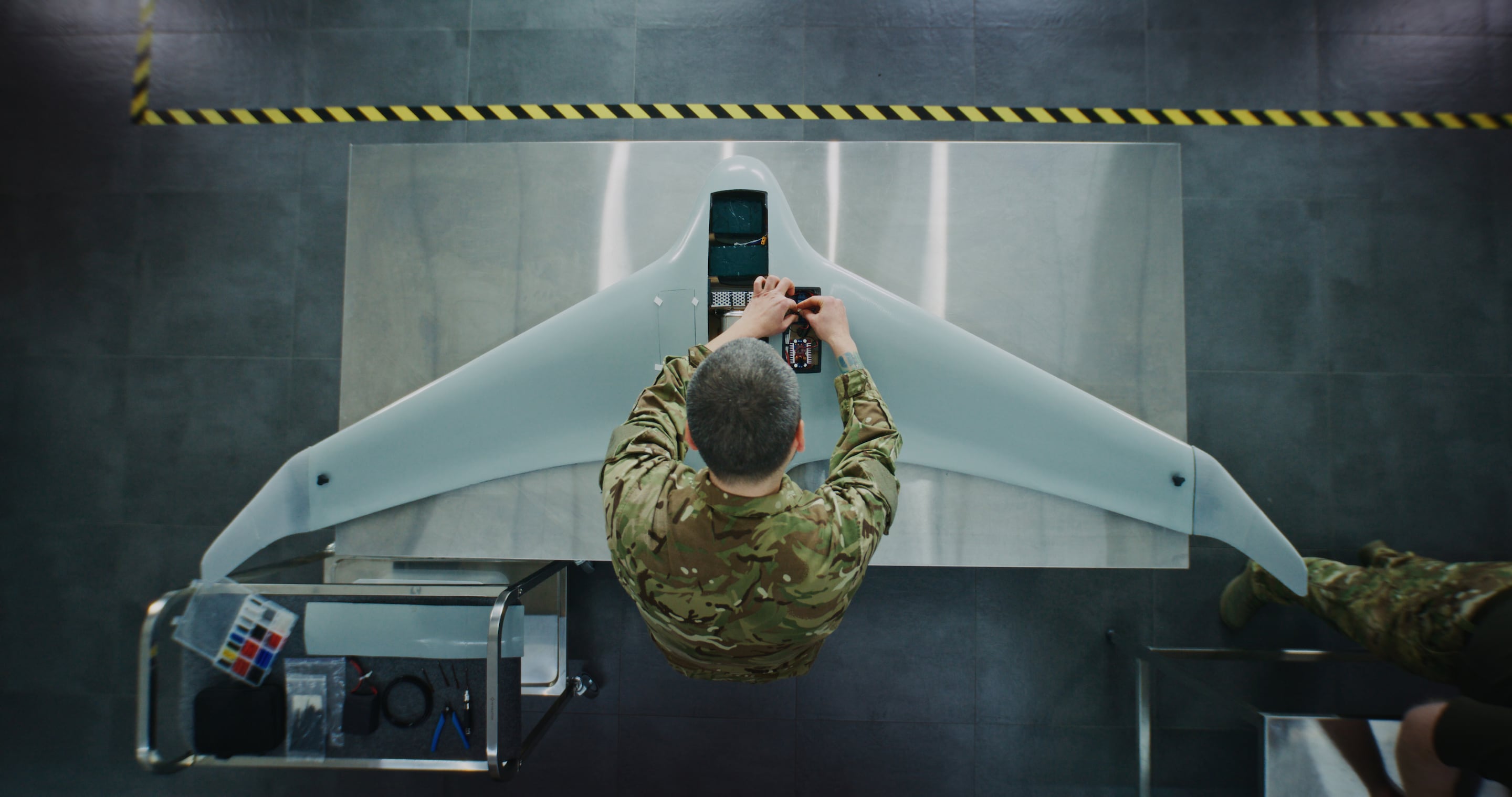
Where global semiconductor innovation powers aerospace and EMEA defense programs
Through global R&D investment, ST engages across the full aerospace and space perimeter worldwide, and defense programs confined to the EMEA (Europe, Middle East, and Africa) region.
ST process technology work spans four decades of building reliable systems that operate at extreme temperatures, under radiation, at the limits of power efficiency, and with the security guarantees that critical infrastructure demands. The ST portfolio addresses these requirements at the component level, drawing on technologies qualified to exacting standards across space, automotive, and industrial applications, and available from a vertically integrated European supply chain.
Autonomous aerial systems illustrate this precisely. A drone platform places simultaneous demands on inertial sensing, motor control efficiency, edge inference, secure communication, and power density that few other applications match. The same FD-SOI and phase-change memory process that gives the STM32V8 its radiation tolerance and 800 MHz edge AI performance in LEO satellite applications applies equally to avionics operating in high-altitude or electromagnetically stressed environments.
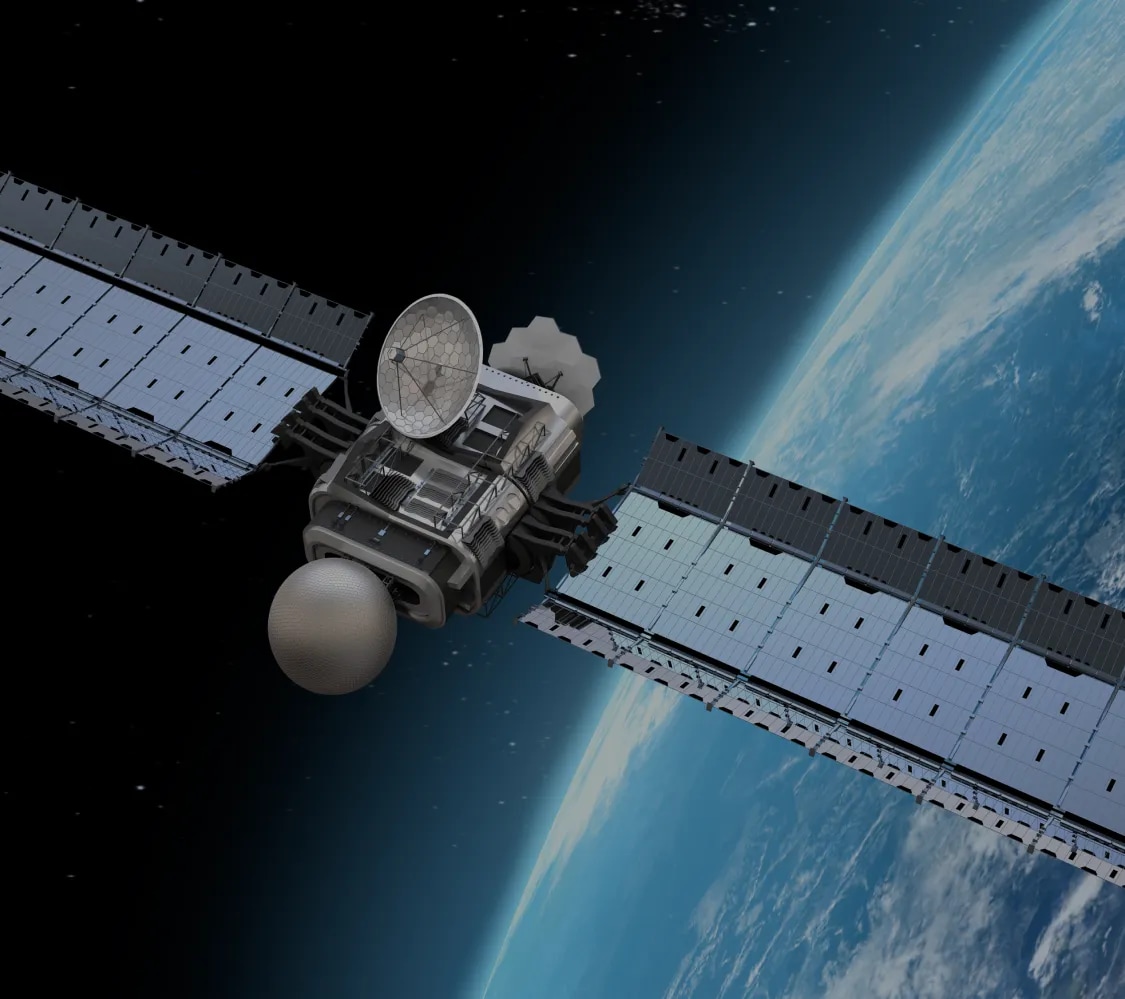
Unmanned Aerial Vehicles (UAV) or drones
Autonomous aerial systems place simultaneous demands on inertial sensing, motor control efficiency, edge inference, secure communication, and power management, all within strict constraints of size, weight, and power. ST's portfolio addresses each of these subsystems at the component level, drawing on process technologies and product families developed and qualified across space, automotive, and industrial applications.
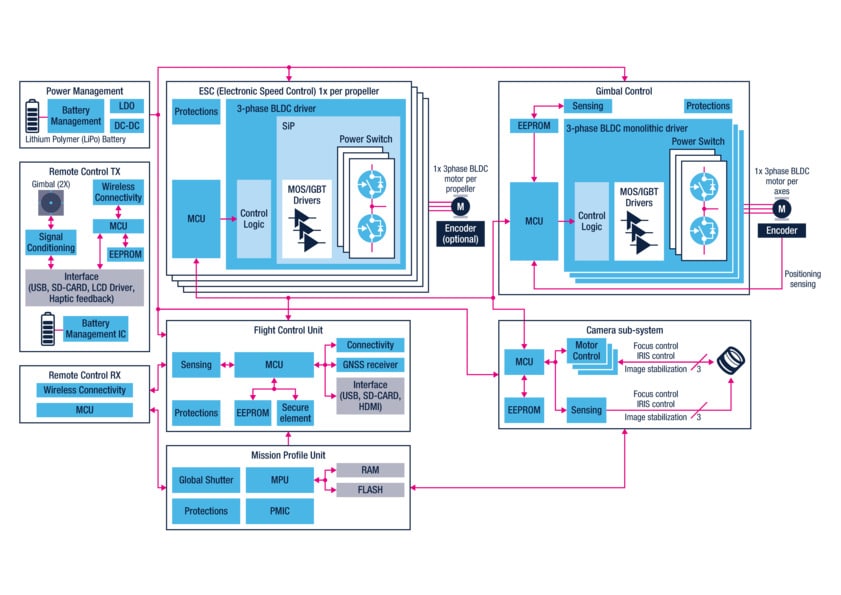
Drones for industrial applications
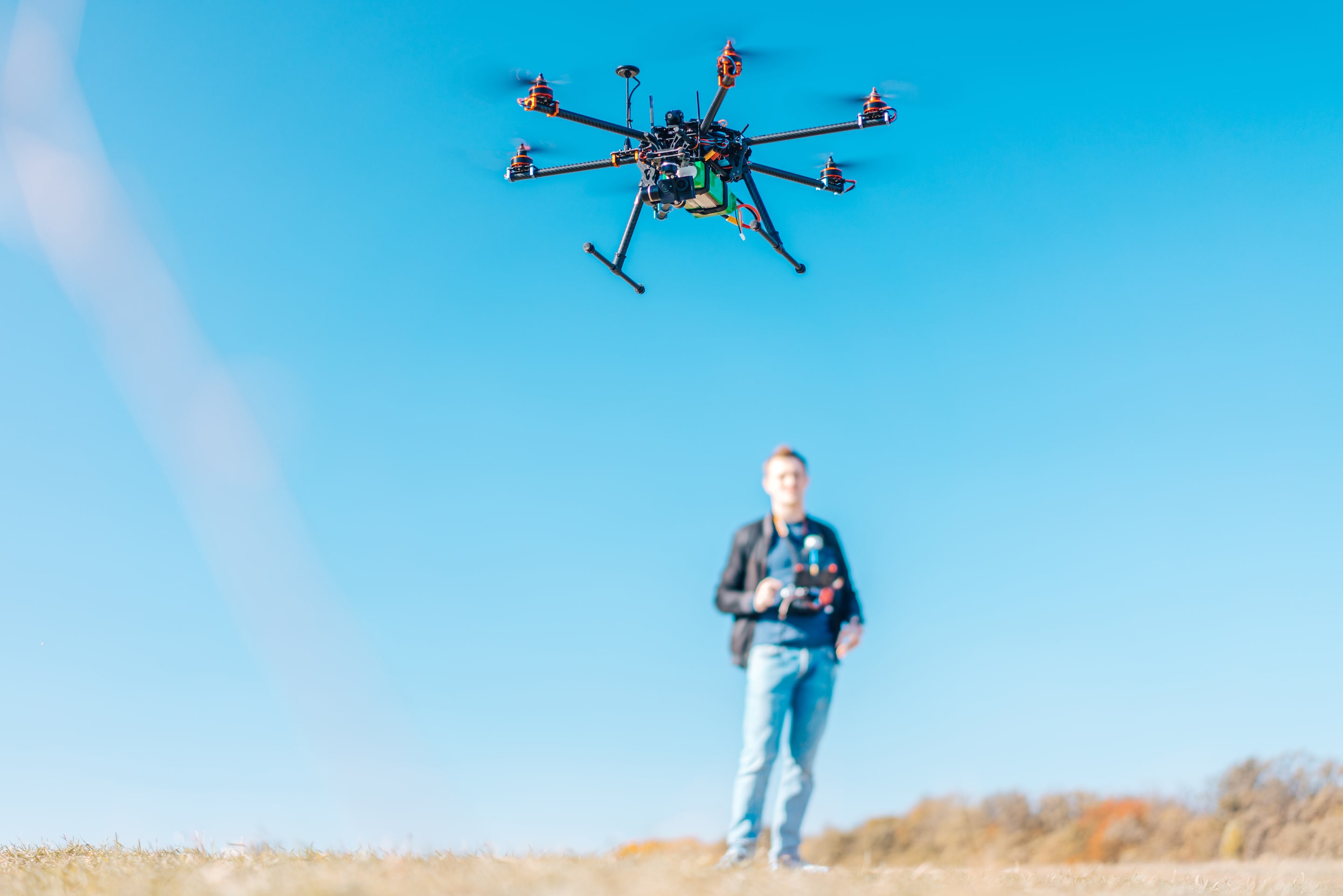
Drones come in a variety of sizes according to the tasks they’re designed for ranging from mini-drones that fit in the palm of your hand to professional and commercial versions capable of carrying substantial payloads or taking still pictures or videos for entertainment or surveillance purposes.
Secure and resilient electronics
Autonomous defense platforms — UAVs, autonomous surveillance systems, AI-assisted situational awareness — extend security and functional safety requirements beyond classical defense reliability standards. An autonomous system that is compromised can be weaponised; one that fails unsafe can cause unintended harm. Both requirements demand a hardware foundation that goes deeper than software or certification alone.
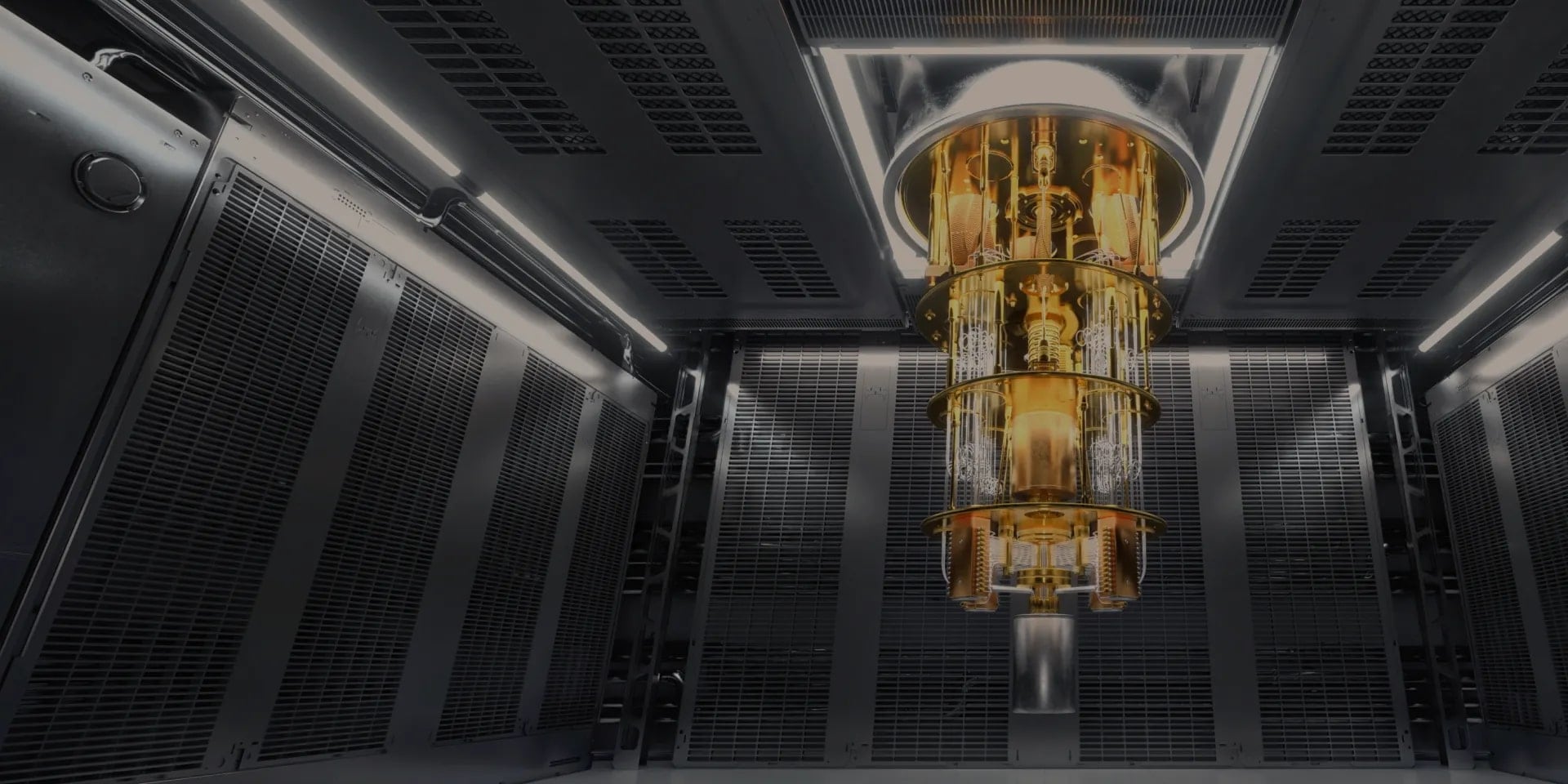
Post-quantum cryptography-ready products
- Long operational lifetimes: a platform fielded today may remain in service beyond 2040, when capable quantum computers become plausibly available.
- Harvest-now, decrypt-later: adversaries collecting encrypted communications today with intent to decrypt when quantum capability arrives. PQC protects against this threat class now.
ST is the only semiconductor company in a position to claim inventorship of a foundational PQC standard algorithm: Keccak, developed by ST researchers, was adopted as SHA-3 by NIST and underlies all current NIST PQC standards. ST's PQC hardware accelerators and X-CUBE-PQC library span STM32, Stellar, and secure MCU families.
European supply chain & sovereignty
Defense procurement decision-makers are required to evaluate supply chain sovereignty for components used in sensitive programs. ST's structure as a European integrated device manufacturer provides a materially different supply chain profile from fabless suppliers or those dependent on foundry capacity outside the European Union.
Integrated device manufacturer
ST operates as an integrated device manufacturer, combining semiconductor research, process development, product design, and manufacturing across its own facilities for a significant part of its portfolio, from materials and process innovation through to qualified components. ST engages with aerospace and defense programs not only as a supplier of parts, but as a technology partner capable of supporting requirements at the design stage.
ST is an active participant in the European defense electronics ecosystem, working in close collaboration with system integrators, Tier 1 suppliers, and research partners across the value chain. For programs with specific technical requirements, ST's engineering teams can engage directly alongside partners to address design constraints, qualification challenges, and roadmap alignment.
For aerospace and defense products where ST front-end or back-end manufacturing forms a key part of the supply chain, the IDM model provides concrete advantages when assessing supply sovereignty and resilience.
End-to-end traceability: Certificates of origin can be traced to specific wafer lots, manufacturing sites, and assembly locations, supporting auditability and compliance requirements for defense programs.
Controlled qualification and change management: Where manufacturing is under ST control, process changes are governed by ST's Product Change Notification framework, ensuring transparency and stability for qualified products throughout their lifecycle.
Credible long-term supply commitments: ST's product longevity programs (10 years, 15 years, and up to 20 years for selected products) are structurally supported where manufacturing infrastructure is owned and operated by ST.
For products that incorporate external foundry or OSAT partners, detailed supply chain and manufacturing information is provided at the individual product level.
European manufacturing footprint
The following lists ST's European facilities and their primary technology roles. ST's broader production network includes external foundry and OSAT partners, and specific products may be manufactured at sites not listed here.
Crolles 300 mm, France
Technology: FD-SOI, Digital CMOS
Defense relevance: Advanced MCU process; PQC hardware IP fabrication
Agrate 300 mm, Italy
Technology: Smart Power, BCD, Mixed Signal
Defense relevance: Power management and analog control ICs
Rennes, France
Technology: Space/HiRel back-end: ESCC, QML-V, JANS-certified assembly, test & qualification
Defense relevance: Certified qualification path for space, defense and HiRel components under European, US, and international agency requirements; DLA Space approved
Catania SiC Campus, Italy
Technology: SiC substrate manufacturing operational; 200mm front-end & back-end lines ramping
Defense relevance: Vertically integrated SiC supply for high-power defense electronics; EU-based
Norrköping, Sweden
Technology: Center of excellence: SiC substrate technology & epitaxy; 200mm substrate pilot line
Defense relevance: European SiC substrate supply — supports Catania device manufacturing ramp
Kirkop, Malta
Technology: Test & packaging (back-end)
Defense relevance: European back-end for defense supply chain
Export control profile
As a company operating under EU jurisdiction, ST products carry a specific and predictable export control profile. For European defense programs involving prime contractors, system integrators, or sub-contractors, EU-origin components can simplify the export licensing process and provide a clean supply chain audit trail for programs with disclosure-sensitive component sourcing requirements
Export control applicability depends on the specific product, its manufacturing origin, and the destination country. Program teams should confirm part-number-level export classification with ST.