Anomaly detection in a motor running at different speeds
Smart sensor node over BLE connectivity to simplify the configuration and to be notified in case of detection via a mobile app.
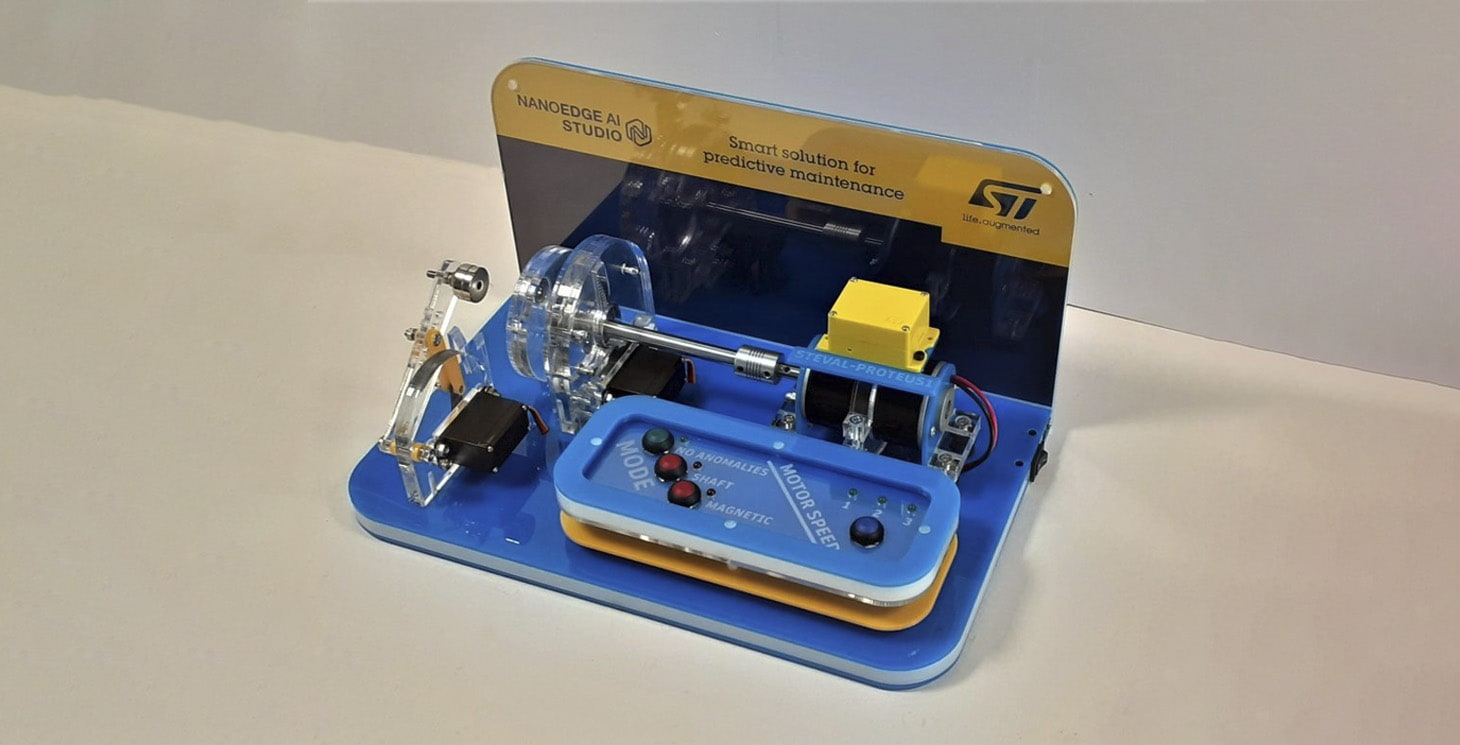

Industrial equipment, such as compressors, spindles, or water pumps, produce different vibrations during operation. Some vibrations may be perfectly normal. Others may be the sign of malfunctioning.
Condition monitoring is the first step in achieving an effective predictive maintenance solution. However, most solutions today send raw data to the cloud for further processing, which is costly and energy consuming. By moving data processing closer to the machine that is being monitored, edge computing reduces infrastructure cost, power consumption, and network bandwidth, since data does not need to be sent to and from the cloud.
In this use case, we used a smart sensor node with a machine learning capability that adapts to the system being monitored and detects early signs of equipment failure. As soon as an anomaly occurs, the equipment user receives alerts through the Bluetooth Low Energy radio embedded in the System On Chip (SoC), allowing him to plan maintenance actions.
Approach
We used the following method to reach our goal:
- Create a dynamic "anomaly detection" model in the NanoEdge AI studio tool.
- Perform a first phase of "on-device learning" to adjust the model and then start the anomaly detection model on the engine.
- Use the FP-AI-PDMWBSOC firmware package and STBLE sensor Mobile App to collect data and test the embedded NanoEdge AI machine learning model on the STEVAL-PROTEUS1 board.
We have also developed a test benchmark on which users can generate two different anomaly detection models using the push buttons: anomalies from shaft misalignments and anomalies from magnet interferences. During the "on-device learning" phase, the operator can use up to three motor speeds (low, medium and high), all of which are considered as normal operation. The device learning and sensing phases run on the STM32WB5M microcontroller module hosted on the STEVAL-PROTEUS1 board. They are controlled by a mobile application remotely.
Sensor
Data
- Regular signals: nominal behavior, 830 signals per speed (low, medium, high)
- Abnormal signals: anomaly behavior, 830 signals per speed per fault (magnet anomaly and shaft anomaly)
Signal length 768 (256 per axis, 3 axis)
Data rate: 1.6 kHz; full scale: 2g
Results
Anomaly detection classes:
99.45 % accuracy, 5.7 Kbytes RAM, 6.9 Kbytes flash memory
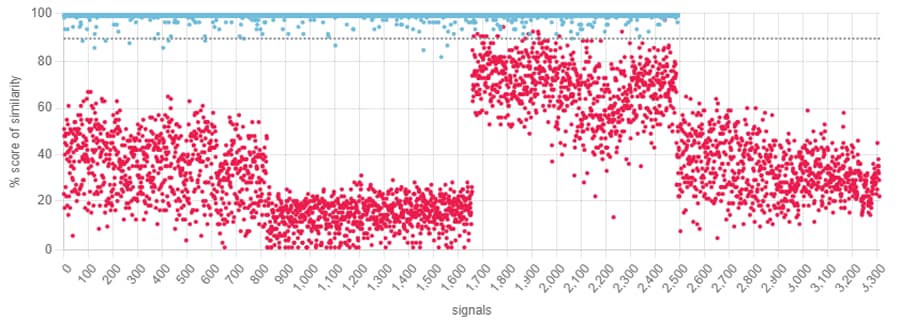
Blue points correspond to normal signals, red points to abnormal ones.
The signal numbers are on the abscissa and the confidence of the prediction is on the ordinate.

Resources
Model created with NanoEdge AI Studio
A free AutoML software for adding AI to embedded projects, guiding users step by step to easily find the optimal AI model for their requirements.
The STM32 family of 32-bit microcontrollers based on the Arm Cortex®-M processor is designed to offer new degrees of freedom to MCU users. It offers products combining very high performance, real-time capabilities, digital signal processing, low-power / low-voltage operation, and connectivity, while maintaining full integration and ease of development.